Wednesday, May 24, 2006

Crystal Healing Considered Dangerous

At a recent used book sale, I picked up a copy of the Bible of crystal healing, Love is in the Earth: A Kaleidoscope of Crystals. The author is "Melody" (no last name given), who describes herself as a "scientist" with "Bachelor of Science and Master of Arts degrees in mathematics". The book was originally published in 1991; I got a copy of the 1995 edition, which has 726 pages.

The first 76 pages of Love is in the Earth consist of a mishmash of New Age nonsense, descriptions of different types of crystals (mostly using invented distinctions not recognized by geologists, mineralogists, or crystallographers), numerology, and a catalogue of how to use crystals to heal. The remaining pages provide a list of minerals, together with a description of what each mineral is good for.

Here is a sampling of the typical sort of hogwash that can be found in this book:

The energies of the mineral kingdom are "universal energies". Hence, when one contacts and is willing to receive this energy, and begins to exercise personal creativity via exercise of the Higher Will, one can contact and synthesize the energies from which the entire universe is comprised. This is the reason that crystals and other minerals are so very powerful and also why their powers must only be used through the highest consciousness of the individual. (p. 32)

Master Number 44: Metamorphosis and continued change throughout all times is concentrated with determination of both the acceleration and the ease of reformation of the self. The concepts of impetus and catalytic motion are reflected in the "forty-four" vibration. (p. 49)

Soak the crystal in brown rice for twenty-four hours; the rice balances and centers the energy, removing the negativity, while dissipating and transforming the negative to the positive. Upon completion of the "soak" the rice is purified and energized and is quite wonderful to eat. (p. 55)

Gasoline mileage has been enhanced by placing a quartz crystal on the carburetor and/or on the fuel line. Increases of up to 50% have been reported. (p. 65)

How anyone could be so foolish as to believe these bizarre, laughable, and unsupported claims is beyond me. Nevertheless, its devotees (nearly always women) can be found by the dozens at gem and mineral shows, picking up each crystal in turn and holding it in their hand with closed eyes, waiting for the crystal to "speak" to them. They are often derided as "healy-feelies" by serious mineral collectors.

What's worse, however, is that this book is potentially extremely dangerous to one's health. First, here is the obvious danger that people who fall for this nonsense might avoid seeking competent medical treatment for serious conditions. For example, Melody recommends the use of a form of sphalerite for "the treatment of AIDS" on p. 592.

Second, Melody recommends various ways of creating "elixirs" on pages 62 and 63; this involves soaking the mineral in water and/or alcohol and then drinking the water. While most minerals are not very soluble in water, this process could still lead the user to consume small amounts of toxic minerals -- particularly because Melody almost never gives any warnings about the toxicity of various minerals.

Take witherite, for example. This mineral is barium carbonate (BaCO3), which is so toxic that it has been used as a rat poison in the past. The fatal dose for an adult human is about 5 grams, which is not that much because of witherite's high specific gravity. (See more about barium carbonate here.) But Melody doesn't say a single thing about the toxicity of this mineral. Instead, she says "It can be used in the treatment of disorders of the digestive system, providing for a cleansing effect on the unitary whole"! (p. 695) Anyone who followed Melody's recommendation and made an "elixir" of witherite might end up solving their digestive problems for good.

Other toxic minerals that Melody recommends for various uses include

  • orpiment (arsenic sulfide) ("can be used to stimulate the intellect, to cleanse and to activate the solar plexus chakra, and to assist one in reasoning capabilities");

  • anglesite (lead sulfate) ("It can be used in the treatment of nervous disorders, to stimulate neural transmitters, and to promote the circulation of blood")

  • the radioactive mineral autunite (calcium uranyl phosphate) ("The energy emanating from autunite has been used to soothe the temper and to ameliorate heart disorders")


For betafite, a mineral which can be extremely radioactive, Melody suggests that it is "used to grid the body, via wearing and/or carrying". I would definitely not recommend wearing or carrying this mineral. You might set off radiation detectors at airports or borders, and you would be exposing yourself to a significant source of radiation, potentially leading to skin or other cancers.

If you know anyone who has fallen for Melody's decidedly unscientific fantasies about minerals, warn them. Many minerals are toxic, and should be handled carefully to avoid ingesting them or breathing their dust.

Monday, May 22, 2006

Dumbest Papal Remarks Yet

Pope Benedict is annoyed with Canada.

Is it Canada's poor treatment of native people that raises his hackles? Or the failure to live up to Kyoto?

Neither. We're not having enough kids.

Yes, you heard that right: Canadians are saying no to the Pope's grotesque vision of women as little baby factories, churning out more and more humans so they can praise his apparently insecure god. Never mind that most of the countries with high birth rates (for example, Congo, Pakistan, Afghanistan) are not societies that would please most of us.

His solution: Canadians must listen to their Catholic bishops. That's right: the way to increase the birth rate is to take instruction from men who have sworn an oath to not have children themselves.

Just when I thought Christianity couldn't get any sillier...

Tuesday, April 25, 2006

Breaking News: A Creationist Dishonestly Doctors a Quotation

Yes, I know it is not really breaking news. Creationists have been dishonestly doctoring quotes for years. But still, each new episode can be breathtaking in its chutzpah.

The latest dishonesty comes from that paragon of boot-licking virtue, Salvador Cordova. In a recent post at Uncommon Descent, he says of intelligent design

Some critics claim that it’s ‘creationism in a tuxedo’. My response to them is: what’s so bad about being in a tuxedo?”

Although it's true that some people have called intelligent design "creationism in a tuxedo", the original citation is the far more damning appraisal that intelligent design is "creationism in a cheap tuxedo". I can understand why ID advocates would want to omit the modifier "cheap". After all, if your tuxedo is expensive, almost anyone can look good. But a cheap tuxedo demonstrates the wearer to be a poseur.

The phrase originates with Leonard Krishtalka, a professor at the University of Kansas and director of the Natural History Museum and Biodiversity Research Center. He used it in a presentation held in 2000 at the Lied Center at the University of Kansas. His use of it is documented in this article from November 2000 by Kansas physicist Adrian Melott, who would later go on to use it as a title of an opinion piece in Physics Today.

So, yet another example of creationists doctoring a quotation to make themselves look better. Stop the presses!

Monday, April 24, 2006

McKnight Gets It

Peter McKnight of the Vancouver Sun has this fine article about the Alters affair. Brian Alters, you may recall, is the McGill University professor who had his grant to study the detrimental effects of intelligent design propaganda on Canadians' understanding of science turned down by the federal granting agency, SSHRC, because (it claimed) there was inadequate "justification for the assumption in the proposal that the theory of Evolution, and not Intelligent Design theory, was correct."

I previously blogged about this sad story here. Incidentally, I finally received a response from SSHRC's Janet Halliwell about my concerns. The response appears to be a form letter, which refuses to forthrightly address the denial letter. In my opinion, in light of her misrepresentations, Professor Halliwell should resign from SSHRC.

Friday, April 14, 2006

Fibonacci poetry

Here
I
would like
to tell you
about a new kind
of poetry
for math lovers.


It
is
based on
a sequence
of Fibonacci
invented eight hundred years ago.


In
this
kind of
poem the
syllables number
1,1,2,3,5,8, then stop.


Do
not
blame me
if you find
this sort of poem
uninteresting. The blame goes
to one Gregory K. Pincus of Los Angeles.


(Hat tip to Mark Gluck.)

Monday, April 10, 2006

Stupid Creationist Letter Award for April

In my monthly feature, the Stupid Creationist Letter Award for April goes once again to a letter published in my college alumni magazine, this time by a certain Lance F. James.

This letter is, if possible, even stupider than last month's. It, too, is responding to President Tilghman's speech arguing that intelligent design is pseudoscience.

Let's play stupid creationist bingo again! Ready?

President Tilghman ... apparently believes that we should base our "science" of origins on faith in naturally occurring spontaneous generation, a notion debunked by Pasteur and a phenomenon never observed by anyone, anywhere at any time.

Amazingly dumb. Mr. James confuses spontaneous generation -- the ancient notion that complicated organisms, such as mice, could arise from decaying plants or meat -- with abiogenesis, the modern theory that the first replicators (likely rather simple molecules) could arise from chemical precursors. I wonder why he thinks Pasteur's experiments, which were performed in the mid-19th century, have anything at all to say about modern theories such as the RNA world?

And don't you love the irony of the theist complaining about unobserved phenomena?

B!

While Dr. Tilghman is clearly free to make faith-based statements grounded in philosophical naturalism, she should not pass them off as hard science, and certainly should not insist that they be the only perspective taught in the nation's classrooms.

Faith-based statements? I see no faith-based statements in Dr. Tilghman's talk. Evolution is based on evidence, not faith. And of course, Mr. James confuses "philosophical naturalism" with methodological naturalism.

I!

Darwinism as an explanation of origins is a theory in crisis.

Yeah, right, anything you say. Too bad Glenn Morton has this great page indicating that creationists have been proclaiming the death of evolution for 150 years now. Morton calls it the "The Longest Running Falsehood in Creationism". And I'll bet anything James considers himself bound by the 9th commandment. Go figure.

N!

The fossil record is a continuing embarrassment to Darwinists.

Now, now, Mr. James. Where's your originality? Can't you come up with anything that's not straight out of the Index to Creationist Claims? But I guess you're right. The fossil record is a great embarrassment to Darwinists. That's why, just this week, the Darwinists were trying their damndest to cover up the latest find, Tiktaalik roseae, a transitional form between fish and tetrapods.

G!

The volume and organization of information in DNA and the irreducible complexity of operating systems within the cell defy construction by Darwinian random variation and natural selection.

Poor Mr. James -- seduced by the nonsense of Behe and Dembski, but unable to see through their smokescreen. I teach Kolmogorov information theory at my university and I can tell you that information is trivial to generate. Any random process, including mutation, will do.

O!

Mr. James, you're a winner of stupid creationist bingo. Congratulations! And I hadn't even gotten to the end of your letter.

My Letter to SSHRC

You may have read about the decision of SSHRC (the Canadian Social Sciences and Humanities Research Council) to deny McGill professor Brian Alters a grant to study the detrimental effects that intelligent design pseudoscience has on Canadians' understanding of evolution.

Here is my letter to SSHRC's President, Stan Shapson. (You can write Stan Shapson yourself, too. Be brief and polite, but firm.)

Dear Stan Shapson:

I am writing to express my incredulity at the reasons proffered by the Research Development Initiatives Program at SSHRC for the denial of a grant to Prof. Brian Alters to study the detrimental effects of intelligent design on the Canadian understanding of evolution.

Your committee wrote, in part,

"Nor did the committee consider that there was adequate
justification for the assumption in the proposal that the
theory of Evolution, and not Intelligent Design theory, was correct."


This is truly preposterous. The theory of evolution is one of the most-tested and best-substantiated theories in science. And, as Alters stated in his proposal, evolution is "the foundation on which all biological sciences are built". Intelligent design, on the other hand, is religiously-motivated pseudoscience pushed by charlatans.

It does not help the reputation of SSHRC that SSHRC's executive vice-president Janet Halliwell was then quoted in the Canadian press as saying Alters took 'one line in the letter "out of context" and the rejection of his application shouldn't indicate [SSHRC was] expressing "doubts about the theory of evolution".' [Ottawa Citizen, April 5]. To put it bluntly, this appears to be spin that is completely contrary to the facts. Prof. Halliwell has not responded to my e-mail inquiry.

An egregious decision has now been made worse by a failure to honestly admit the mistake and attempt to rectify it. I want to know how you plan to address this failure and I look forward to a prompt response from you.

Yours sincerely,

(Prof.) Jeffrey Shallit

Tuesday, April 04, 2006

Worst Interview Ever

I just had the worst interview ever, with CHTV in Hamilton.

In my capacity as Vice-President of Electronic Frontier Canada (now sadly somewhat dormant) I do television and radio interviews. This was a phone interview for a TV show, a strange concept in itself.

The subject was ostensibly Craig Legare, an Edmonton man who was recently acquitted of attempting to lure a 12-year-old girl over the Internet for sexual purposes.

The show's producer, Lawrence Diskin, contacted me on Monday to see if I was willing to do an interview. In my preliminary discussion, I had pointed out that the problem is nothing new; as long ago as 1905, an editorial in the journal Telephony asked, "The doors may be barred and a rejected suitor kept out, but how is the telephone to be guarded?" I expected a calm discussion of how changing technology interacts with the law, and that's what the producer said he wanted. He didn't inform me others would be in on the interview.

When they called at 1:30 PM, I was surprised to find that Roy Green (apparently some right-wing local radio personality) would be on with me, as well as David Butt, who if I'm not mistaken was involved as Crown counsel in the grotesque and farcical 1993 police confiscation of paintings by artist Eli Langer.

No surprise, then, that the interview was just looking for a "gotcha" moment. When I pointed out that laws against luring must be crafted narrowly to avoid criminalizing things like sex education classes, or kids chatting about sex with each other, or reading each other Romeo and Juliet, the host immediately began to demagogue, asking "What about common sense, Jeffrey?" He wasn't interested in listening to my point.

Laws are bad when they are focused on a single medium of communication -- they make the mistake of attacking on the medium and not the message. If luring children for sexual purposes is the problem, let's make laws that address that problem, and not gear them to the Internet. Children can be lured just as well by someone leaning over your backyard fence, or calling your children on the phone when you are not home. The Internet isn't some entirely new threat; it just makes it easier. And laws geared to current media may prove inadequate when media change.

We should craft laws that address the behavior we consider criminal, and the laws should be so narrow that they don't also capture behavior we would consider legitimate. That was my point. I tried to make it, but the host was so intent on demagoguing, it seemed to go over his head.

Friday, March 31, 2006

Moose News Roundup

Here's the Friday moose news roundup:

From the Edmonton Sun, we learn that Robert Lee McLaren of Pugwash Junction, Nova Scotia, has received a 20-year hunting ban for shooting a robotic moose.

From Aftenposten in Norway, we are saddened to learn about a flying moose that landed on the roof of a Mazda driven by Leo Henriksen. The poor moose bounced off the roof and then was hit by a car driven by Randi Olsen.

From MSNBC, we can view a video of a moose that crashed through the windshield of a car in Leominster, Massachusetts driven by Juleigh McDowell, and ended up sitting in the passenger seat with its head out the broken window.

And finally, from the Anchorage Daily News, we have this photo of a young moose that crashed through the roof of a shed in Alaska.

All in all, the life of a moose is difficult.

Tuesday, March 21, 2006

Stupid Creationist Letter Award for March

The letters section in my college alumni magazine is always a source of amusement, with its monthly fulminations by doddering retirees about some new outrage. When I was a student, the alumni (including, to my shame, our latest Supreme Court justice) were incensed by the admission of women and gays. Now the outrage is directed towards President Tilghman, who had the temerity to point out that intelligent design is a religiously-motivated crock.

A certain Thomas V. Gillman from the class of 1949 raises the usual specious objections. Are you ready to play anti-evolution bingo with some excerpts?

"...she [President Tilghman] dismisses the arguments for 'intelligent design' as specious and representative of only the voice of Christian fundamentalists. That simply is not so." Really? Then how does he explain this quotation of William Dembski, who is one of the leaders of the movement? "I think at a fundamental level, in terms of what drives me in this, is that I think God's glory is being robbed by these naturalistic approaches to biological evolution, creation, the origin of the world, the origin of biological complexity and diversity. When you are attributing the wonder of nature to these mindless material mechanisms, God's glory is getting robbed." (Fellowship Baptist Church, March 7 2004)

B!

"The evolutionary theory of natural selection is just that, a theory." Yes, "only a theory", the hoariest chestnut in the creationist playbook!

I!

"Dr. Tilghman speaks of [evolution's] remarkable resilience to experimental challenge over almost 150 years' as evidence of its validity, when this is really nothing but an admission of failure on the part of the scientific community to ratify the theory..." Do I understand correctly? The fact that evolution has survived every experimental test means, according to Gillman, that the theory has failed? Alex, I'll take "incoherent babble" for $100!

N!

"It [evolution] is not a biological law". The usual misunderstanding about the distinction between "theory" and "law"!

G!

"...it [evolution] has become increasingly tenuous, as indicated by the numerous writings raising objections to it." Yes, the old many scientists reject evolution chestnut!

O! BINGO! We have a winner! Mr. Gillman, you are the winner of this month's Stupid Creationist Letter Award! Congratulations.

P. S. For more Gillman fun, see here.

Monday, March 20, 2006

Islam: Religion of Tolerance?

From today's Associated Press, we learn that an Afghan man could be sentenced to death for converting to Christianity.

The judge is reported to have said "We are not against any particular religion in the world. But in Afghanistan, this sort of thing is against the law. It is an attack on Islam... The prosecutor is asking for the death penalty."

Saturday, March 18, 2006

Nancy Pearcey: The Creationists' Miss Information

I don't know about you, but whenever I want to learn about information theory, I naturally turn to the creationists. Why, they know so much about geology, biology, and paleontology, it only seems reasonable that their expertise would extend to mathematics and computer science.

Take Nancy Pearcey, for example. Here, for example, we learn that Ms. Pearcey has studied philosophy, German, and and music at Iowa State; that she has a master's degree in biblical studies; that she is a senior fellow at that temple of truth, the Discovery Institute; and that for nine years she worked with former Watergate conspirator and convicted criminal Charles Colson on his radio show, "Breakpoint". Why, those seem exactly the sort of credentials one would want in an instructor of information theory.

Infused with a thirst for knowledge, I headed immediately to my university's library to get her 1994 book co-written with Charles Thaxton, The Soul of Science: Christian Faith and Natural Philosophy. I didn't let the fact that it was donated by Trinity Missionary Church deter me; after all, this fine institution has donated other important books to our library, such as Larry Witham's By Design: Science and the Search for God.

The endorsements for The Soul of Science reassured me I was on the right track. David Shotton, a biologist at Oxford had this to say: "...the clarity of their explanations for the nonspecialist, for example, of Einstein's relativity theories or of the informational content of DNA and its consequences for theories of prebiotic evolution, are quite exceptional, alone making the volume worth purchasing." And there were equally enthusiastic endorsements from other experts in information theory, such as Phillip Johnson and Stephen Meyer.

I then turned to page 239. There I read the following explanation of information theory:


A structure with no order at all---for instance, a random set of letters---requires few instructions. If you want to write out a series of nonsense syllables, you need only two instructions: 1) "Select at random a letter of the English alphabet (or a space) and write it down," and 2) "Do it again." In the natural world a pile of leaves is random. It can be specified by saying 1) "Select at random some type of leaf --- oak, maple, birch --- and drop it on the pile," and 2) "Do it again." A random structure can be specified using few instructions. Hence it has a low information content.


Well, I think everyone would have to agree that this explanation is exceptionally clear and geared to the nonspecialist. Unfortunately, it is completely wrong.

According to information theory as elucidated by Kolmogorov, one does indeed measure the information content of a structure in terms of its shortest description. A string of a thousand A's "AAA.....A" has low information content because we can encode it as "Print A 1000 times". But it is a basic result of the theory -- so basic that I prove it in the very first class on Kolmogorov complexity at my university -- that a string of letters chosen uniformly at random has high information content, with very high probability. That's because such a random string is very unlikely to be generated by a simple program.

Where did Pearcey and Thaxton go wrong? They make two mistakes. First, although the procedure they suggest ("select at random a letter" and "do it again") indeed appears to be short, it does not constitute a description of a specific string. Run their procedure a second time, and you'd get a different string. Second, in Kolmogorov's theory, the description of a string must be completely deterministic; no "select at random" instructions are allowed. These are the kind of mistakes that could only be made by people completely unfamiliar with even the most basic aspects of information theory.

Of course, Pearcey and Thaxton aren't really interested in the information content of sentences or leaf piles. Their goal is to demonstrate that life is too complex to have evolved through natural means. But since high information content can result from random events -- for example, mutation -- it is not surprising at all that DNA can be viewed as a string with high Kolmogorov information. In fact, as Greg Chaitin has observed, pretty much the only way to get large amounts of information in the mathematical sense is to either do a really long calculation, or to exploit a source of randomness. DNA's high information content is prima facie evidence it resulted, in part, from an essentially random process.

So I left the library, disillusioned. How could the creationists be so wrong? Could they have allowed their personal religious beliefs to get in the way of their understanding? Or could they be deliberately misinforming the public to support their evangelical goals? No, the answer is clear: all the experts in information theory must be suppressing the truth.

Obviously, my classes on Kolmogorov complexity must take on a new aspect: teach the controversy!

Friday, March 10, 2006

Erin My Views

Yesterday I traveled to Erin, Ontario, to participate in their Extended Learning Opportunities (ELO) lecture series. This venerable series of lectures is now in its 25th year, and features lectures by professors and others on topics of current interest.

My talk was entitled "Intelligent Design: Creationism in a Cheap Tuxedo", and was well-attended by about 60 people, mostly retirees.

Here's a brief summary of my talk. I started with the impact of Darwin's theory of natural selection, and how it inspired a creationist backlash. I talked about the influence of Canadian "flood geologist" George McCready Price and the recently-deceased Henry Morris. I then talked about and debunked six standard creationist claims:

  1. The earth is only 10,000 years old
  2. Fossils are the result of Noah's flood
  3. Evolution is only a theory
  4. The theory of evolution does not make predictions
  5. Beneficial mutations have not been observed
  6. The Cambrian "explosion" contradicts gradual evolution

I also talked about the common creationist tactics of quote mining, quote editing and misrepresentation, and quote fabrication. I showed how Henry Morris fradulently altered a quote from a paper of Ross and Rezak to support his claims about the Lewis thrust fault.

I briefly mentioned how the creationists lost court decisions such as Epperson v. Arkansas, McLean v. Arkansas, and Edwards v. Aguillard, and how this is the backdrop for the neo-creationists, the intelligent design movement.

I showed pictures of Michael Behe, William Dembski, Phillip Johnson, and Jonathan Wells, and emphasized that they are educated, intelligent people with advanced degrees.

I talked about Michael Behe and his book, Darwin's Black Box. I defined irreducible complexity, and using the examples of John McDonald and Kenneth Miller, showed why irreducible complexity is no bar to evolution. I talked about William Dembski, and his pseudomathematical claims about evolution, and why they were wrong. I showed Dembski's praise of Henry Morris, emphasizing the commonality between creationism and intelligent design.

I then talked about the Kitzmiller v. Dover intelligent design case, and discussed my (small) role in the case. (I was asked by the ACLU to be a rebuttal witness against Dembski. Although I was deposed in the case, Dembski dropped out, and so I was not needed to testify.) With the aid of Nick Matzke's wonderful slides, I showed how the textbook Of Pandas and People took passages that previously referred to "creationists", and changed them, sometimes incompletely, to "intelligent design proponents".

Next, I discussed the "teach the controversy" ploy, pointing out Robert Camp's recent survey of reseach universities, in which nearly every respondent said there was no genuine scientific controversy regarding evolution vs. intelligent design.

Finally, I put up a slide entitled "Why does it matter?" and explained how understanding evolution was crucial to being an informed public citizen on issues such as AIDS, biodiversity, and agriculture. I concluded by putting up the last frame from Ruben Bolling's cartoon, in which the foreign student says, "Yes, America, we would like very much if you would teach your children religious dogma instead of science. We'd like their jobs."

I have to admit, I had some trepidations about giving this talk in Erin, a small town in a part of Ontario known for its strong religious views. However, the reaction was surprisingly positive. Although there was spirited question-and-answer session that lasted 40 minutes, and the questions were acute and probing, there were no really hostile reactions at all. Most people appeared surprised that others would be taken in by the sham of creationism and intelligent design, and were quite comfortable with reconciling evolution with their religious views.

Although it is not easy, I tried to present the claims of creationism and intelligent design fairly, without ridicule. Afterwards, I was pleased about the kind words I received about the presentation. Several people particularly commented about my fairness.

I encourage others to try to take part in this public outreach. For too many years creationists such as Kent Hovind and Ken Ham have been preaching their fraud to a gullible public. As scientists, we need to take the initiative to get the real story out.

Wednesday, March 01, 2006

Solution to the Birthday Puzzle

Yesterday I posed the following puzzle: On what day of the year do the most people celebrate their birthday?

The answer I expected was, in fact, yesterday: February 28. The rationale is that about 1/(4*365) of all births fall on the leap day, February 29 --- so roughly 3 out of every 4 years, those lucky leapday people have to celebrate on some other day. For psychological reasons it seems very likely that most people will celebrate on February 28 instead of March 1, so this means that February 28 gets a boost of up to 3/16, or 18.75% more celebrants, averaged over many years.

This analysis, however, doesn't take into account the fact that human birthdays are not uniformly distributed. I've found several datasets on the web and in the literature, and each of them exhibits rather wide variablity. For example, an article by Geoffrey Berresford in Mathematics Magazine 53 (1980), 286-288 reveals that for one dataset (births in New York State for the calendar year 1977), the least likely day to give birth was December 11 (.2135%) and the most likely was July 6 (.3478%). The percentage spread for this dataset is 100%*(max-min)/min is 62.9%, easily large enough to swamp the leap year effect! In particular, significantly more people are born during July, August, and September than January, February, March, and this could easily change the results.

However, there are at least two problems with relying on the data from a single year. First, there is a huge weekly fluctuation in birthdays. At least in North America, people are much less likely to be born on a weekend than on a weekday. I imagine this is due, in part, to the fact that many people are born via Caesarean section, and doctors tend to take the weekends off. (A more sinister explanation might be that doctors tend to manipulate birth times with drugs to make sure they occur during a weekday.) Thus, we cannot rely on the data for single day, but need to average this over many years to make sure we get accurate data. Fortunately, there are some other datasets available. This one appears to be for the year 1978; it has a spread of 50.1%. One commenter suggested looking at this dataset, represents applications received over a 14-year period from a life insurance company, and so probably tends to average out the weekly effects. It has a spread of only 38.5%, if one ignores the data for February 29.

A second, but related problem is that some dates are more likely to fall on a particular day than others. For example, the 13th of the month is more likely to fall on a Friday than any other day! (This was noticed as early as 1933 in a Monthly problem; for the reference and an explanation, see here.) As it turns out, February 28 falls on a weekend 28.75% of the time, and February 29 falls on a weekend 28.5% of the time, whereas a uniform distribution would give about 28.57% for both. Coupled with the observation in the previous paragraph, this might be another reason why February 28 might be under-represented, although the effect is quite small, affecting only the 3rd decimal place.

If we use the insurance data mentioned above, then there were 1319 births on February 28 and 325 on February 28. Since in 3 out of every 4 years, the leapies will celebrate their birthdays on February 28, this gives an effective score of 1319 + (3/4)*325 = 1562.75 for February 28. This just barely beats out the otherwise-most-frequent date of August 15, with 1559 births. Here the difference is in the 3rd decimal place! Maybe February 28 really is the most frequently celebrated after all, but if so, it's very close.

Tuesday, February 28, 2006

A Birthday Puzzle

On what day of the year do the most people celebrate their birthday?

For the answer, see here.

Saturday, February 25, 2006

Larry Witham: ID Flack

I am currently re-reading Larry Witham's 2003 overview of the intelligent design movement, By Design: Science and the Search for God. Those who follow the ID movement closely know Witham as a former religion reporter for the Moonie-controlled Washington Times, and as the author of several uncritical articles about ID. Another tip-off that the content would be slanted was that this volume was donated to my university by the Trinity Evangelical Missionary Church, a local group that has donated a significant fraction of the antievolutionary content of our library. So it did not come as a surprise to me in my first reading that By Design was slanted. What did come as a surprise was the level of bias and misrepresentation, even to the point of blatant self-contradiction. I've finally gotten around to listing some of them.

A complete catalog of the misrepresentations would take dozens of pages, so I'll just focus on two chapters, entitled "The Movement" and "By Design".

On page 116, Witham says "What struck [Charles] Thaxton most, however, was that apparently no one in the science community dared raise the question of information. Much as a written page suggests an author, complex chemical information in DNA suggests the work of a mind---a key argument that was to be developed in the intelligent design movement. Leslie Orgel had mentioned the information puzzle in a footnote and used the term specified complexity to explain why the DNA codes were so different from redundant crystal structures."

And on page 117: "Nobody talked about DNA as "information" because it smacked of intention, not of chance and law."

So, is it really true that "nobody" talked about information with respect to DNA? And is the reason why that "information" suggests the work of a mind?

No. Once the structure of DNA was elucidated by Watson and Crick, the idea of DNA as a carrier for information occurred to everyone. In his classic 1958 paper, "On Protein Synthesis", which appeared in a Cambridge University Press volume entitled The Biological Replication of Macromolecules, Crick wrote (pp. 143-144):


"A systematic discussion of our present knowledge of protein synthesis could usefully be set out under three headings, each dealing with a flux: the flow of energy, the flow of matter, and the flow of information. I shall not discuss the first of these here. I shall have something to say about the second, but I shall particularly emphasize the third--the flow of information.

"By information I mean the specification of the amino acid sequence of the protein...

...

"As in even a small bacterial cell there are probably a thousand different kinds of protein, each containing some hundreds of amino acids in its own rigidly determined sequence, the amount of hereditary information required for sequentialization is quite considerable.

...

"In other words, the viral RNA appears to carry at least part of the information which determines the composition of the viral protein."
(emphasis in original)

Crick introduced two important ideas in this paper. The first was the "Sequence Hypothesis":


"In its simplest form it assumes that the specificity of a piece of nucleic acid is expressed solely by the sequence of its bases, and that this sequence is a (simple) code for the amino acid sequence of a particular protein."


The second was what Crick jokingly called the "Central Dogma":


"This states that once 'information' has passed into protein it cannot get out again. In more detail, the transfer of information from nucleic acide to nucleic acid, or from nucleic acid to protein may be possible, but transfer from protein to protein, or from protein to nucleic acid is impossible. Information means here the precise determination of sequence, either of bases in the nucleic acid or of amino acid residues in the protein."


So, contrary to Witham and Thaxton, not only was the term "information" being used by the biological community well prior to Orgel's use of the term "specified complexity" in 1973, it constituted an important part of one of the most fundamental papers of the field.

Even well before the structure of DNA was deduced, information-like ideas in biology were obvious even to non-biologists. While he did not use the term "information", Erwin Schrödinger, in his celebrated 1943 series of lectures entitled What is Life?, stated that the "most essential part of a living cell--the chromosome fibre--may suitably be called an aperiodic crystal" (emphasis in original) and spoke of chromosomes as an "hereditary code-script". And the same year as Watson-Crick, a 1953 volume, edited by Henry Quastler, was entitled Information Theory in Biology.

Now here's the ironic part. After claiming on page 116 that "nobody in the science community dared raise the question of information", only 29 pages later Witham himself discusses "information" and the Crick's "sequence hypothesis", on page 145 of By Design! Being an ID flack means consistency gets thrown out the window.

Another tool of the ID flack is to praise the work of creationist hacks. For example, on p. 117 Dean Kenyon's book Biochemical Predestination is labeled as "seminal". Now a truly seminal work in biology would received hundreds of citations. According to the on-line citation search "Web of Science", Biochemical Predestination got 25. Sorry, 25 citations does not make a work seminal. (By contrast, Dawkins' book The Selfish Gene has over 3000 citations.)

Witham claims Thaxton's book The Mystery of Life's Origin (co-authored with Bradley and Olsen) "was unique in laying out all the current origin-of-life theories and how they fell short". Funny, I thought Shapiro's Origins, published about the same time, did that too. He also claims Thaxton's book "opened a new debate". But not much of one, it appears. Web of Science reveals only 25 citations, some of which are by other ID hacks such as Stephen Meyer, Rob Koons, and Henry Schaeffer.

On page 118, Witham favorably mentions Michael Denton's critique Evolution: A Theory in Crisis. But he does not mention that Denton's work was riddled with flaws and misunderstandings.

Here's how, on page 119, Witham discusses criticism of the book Of Pandas and People: "Attacking the book became a pastime for evolutionists in public education and the American Civil Liberties Union". But there is not a single mention of any of the many false claims and misrepresentations in Pandas.

On page 123 we have John West (yet another ID hack) wondering, "Where does information come from?" But don't expect Witham to point out the pure idiocy of this question and the simple answer it has (information comes from randomness).

On page 132, Witham claims "Behe keeps up his research". Not so. John Lynch, at Stranger Fruit, examined Behe's research record and concluded that he has published hardly anything with scientific content since 1998.

On page 146, Witham discusses Dembski's "complex specified information" (CSI). He claims it "exists in nature and in the scrambled security codes on credit cards". Here Witham seems confused. To my knowledge Dembski has never spoken about "scrambled security codes on credit cards". Rather, in Intelligent Design: The Bridge Between Science & Theology, Dembski claimed that it was the number on the credit card itself, not the security code, that constituted CSI. Witham treats CSI as if it were a coherent concept, completely ignoring the many critiques of Dembski's work, even though they were available long before By Design was published.

Witham ends his Chapter 8 by quoting physicist Paul Davies as follows: "Dembski's attempt to quantify design, or provide mathematical criteria for design, is extremely useful. I'm concerned that the suspicion of a hidden agenda is going to prevent that sort of work from receiving the recognition it deserves. Strictly speaking, you see, science should be judged purely on the science and not on the scientist."

I have to admit, I'm not terribly impressed with Davies and his understanding of information theory. I wrote once to correct some mistakes he made in The Fifth Miracle, and, to his credit, he eventually wrote back, admitting his errors and offering to correct them in a future edition. Later I asked him how, precisely, he thought Dembski's ideas were "useful", and what Dembski had to offer that was over and above the work of Kirchherr, Li, and Vitányi. He wrote back saying he did not want to be drawn into a debate. I note that Davies did not say he stood by his previous assessment of Dembski.

Witham could have, instead, ended his chapter with another view of Dembski's work, from David Wolpert: "I say Dembski "attempts to" turn this trick because despite his invoking the NFL theorems, his arguments are fatally informal and imprecise. Like monographs on any philosophical topic in the first category, Dembski's is written in jello. There simply is not enough that is firm in his text, not sufficient precision of formulation, to allow one to declare unambiguously 'right' or 'wrong' when reading through the argument. All one can do is squint, furrow one's brows, and then shrug."

But of course, ID flacks like to pretend that legitimate criticism doesn't exist. If you've read this far, here's the moral: if you are looking for an honest and accurate assessment of intelligent design, don't turn to a flack like Larry Witham.

Friday, February 24, 2006

Christian Grad Student Fails to Prove Discrimination

The latest issue of the CAUT Bulletin (organ of the Canadian Association of University Teachers) reports that the British Columbia Human Rights Tribunal has dismissed a complaint by a Christian graduate student that she was discriminated against because of her religion.

I don't approve of Canada's human rights tribunals, because they have in the past acted in ways contrary to free speech. But it is a relief to see they decided rightly in this case.

Cynthia Maughan, a Master's student in English, had complained that one of her graduate seminar classes was held on Sunday, making it unable for her to attend. However, she admitted she didn't regularly attend church, and that she sometimes did school work on Sundays. Her instructor, Lorraine Weir, apparently offered her a work-around on the class, but didn't change the date of the seminar. Maughan also complained about an e-mail message in which a student "fondly re-[called] the stoning of Christians", and that her case was unfairly discussed at a 2004 conference at UBC and in a faculty association newsletter.

Judy Parrack, a member of the Human Rights Tribunal, dismissed the complaint in its entirety. About the last complaint, she wrote "Ms. Maughan seems to suggest that if an individual responds to, or speaks of, an allegation of discrimination, that response serves to further the discriminatory conduct and thus constitutes a continuing contravention of the Code. With respect I disagree. If Ms. Maughan were correct, it would mean that no respondent could defend or speak about allegations made against him or her in a public document. Ms. Maughan filed an action with the Court, an action that is a matter of public record, and should have expected that some consequence would result."

From what I can see, Maughan took a simple dispute that could have easily been resolved and turned it into a huge and unnecessary battle for Christianity. With Christians an overwhelming majority in Canadian society, I really don't understand the proclivity of some Christians to view every incident through the lens of martyrdom. Universities accommodate Christians to an extent not provided to any other religion---Jews, for example, don't get Yom Kippur off as an official university holiday. And the remark about "stoning Christians" was offered in response to a remark by far-right politician Stockwell Day, and was clearly not intended to insult Christians in general.

Maughan is still pursuing an independent $18 million civil lawsuit against UBC, Lorraine Weir, and three other professors. $18 million represents about 2% of UBC's annual budget, as noted here.

Maughan's case became something of a cause celebre for conservative Canadian Christians. Now that the Human Rights Tribunal has dismissed her complaints, I can only hope that the civil suit gets similar treatment.

Monday, February 20, 2006

D'Oh(n): The Simpsons and Mathematics

An interesting article in the Fall 2005 issue of Emissary, the newsletter of the Mathematical Sciences Research Institute, reveals that a number of people associated with the TV show The Simpsons have mathematical backgrounds. Ken Keeler, for example, has a Ph. D. in applied math from Harvard, and Jeff Westbrook has a Ph. D. in computer science from Princeton. (I guess that makes up for the fact that the voice of Bart, Nancy Cartwright, is a member of the Scientology cult.)

For more information, see simpsonsmath.com, a website created by Sarah J. Greenwald that documents some of the "in" math jokes contained in the show, and in particular this page that documents some of the mathematical connections of the writers and producers of the show. Almost makes me wish we had a working TV!

Stil not satisfied? Visit The Definitive Frink, a website devoted to the Professor Frink character.

Sunday, February 19, 2006

A Headline We Never See

Terry Mosher, cartoonist for the Montreal Gazette under the pen-name Aislin, has kindly allowed me to reproduce his cartoon from March 5, 2002:

Why Intelligent Design Fails Available in Paperback

Why Intelligent Design Fails: A Scientific Critique of the New Creationism will soon be out in paperback!

I was honored to contribute a chapter (co-written with Wesley Elsberry) to this book, which also features chapters by Taner Edis, Matt Young, Gert Korthof, David Ussery, Ian Musgrave, Alan Gishlick, Niall Shanks, Istvan Karsai, Gary Hurd, Mark Perakh, and Victor Stenger. The book's editors were Matt Young and Taner Edis, and it was published by Rutgers University Press. (For more information about the book, see here.) I was pleased to see that it sold much better than expected (but alas, I don't get any royalties) --- so well that Rutgers has decided to release a paperback version.

This version sells for only US $24.95, and you can order it at amazon. Buy a copy, and donate it to your local public library!

Postscript: I just learned that an even better deal is available from the Rutgers University Press website: you can get a copy for just $19.96.

Thursday, February 16, 2006

Courses Have Consequences

John Tibbits, president of our local community college, Conestoga College, is all upset because McMaster's new satellite medical school will go in a new downtown Kitchener campus of the University of Waterloo, and not at Conestoga. In an article in our local paper, the Kitchener-Waterloo Record, he suggested the decision was not "rational" or "logical".

Is it possible that Conestoga didn't get the new medical school because they have a history of offering courses that endorse quack therapies, such as HOLI8170 (Reflexology) and HOLI8120 (Therapeutic Touch)? Or because they have a history of offering courses that tout pseudoscience, such as META0110 (Psychic World), META0130 (Advanced Psychic World), and META0060 (Reincarnation - Who Were You?)?

I'm sure many of Conestoga College's courses are not as wacky as these, and most are probably very helpful to the people who take them. But courses have consequences. If your curriculum contains nutball entries, and you offer them year after year even after people have complained, don't be surprised if some legitimate scientists and physicians don't want to be associated with you.

Monday, February 13, 2006

Does the God of the Bible Exist? - A Debate Report

I attended the February 11 debate sponsored by the Kitchener-Waterloo-Cambridge-Guelph Humanists. It was entitled "Does the God of the Bible Exist?" and featured Chris diCarlo of the University of Ontario Institute of Technology versus Scott Wilkinson, pastor of the New Creation Reformed Presbyterian Church.

The debate was held as a "Darwin Day" feature which, to my mind, was an unfortunate choice because of the implication that evolutionary biology is for atheists only. Here is my report on the debate, with my own rebuttals in italics and red.

Pastor Wilkinson started the debate by disputing the definition of "faith" as "belief in the absence of evidence". He said that the bible says that faith is knowledge based on reason, on evidence. Next, he disputed the view that scientific evidence is the only legitimate evidence. Many things, he said, are known and proven, but not based on science. Four of them are the existence of numbers, the laws of logic, morality, and personal self-consciousness. He stated that the belief in naturalism is not based on evidence and claimed that scientific knowledge is actually based on men. Is science based on evidence you personally have seen and tested? he asked. He quoted Guth to the effect that scientific phenomena are not directly observed.

He then claimed that the Christian god is an objective reality which is empirically provable, and unbelief is inexcusable. The Christian world view is true because its negation is impossible. He presented an argument which he called the "transcendental argument": the laws of logic are necessary for all rational argument. Therefore, you must maintain that the laws of logic are real and invariant. But in a materialist world there cannot be laws of logic because logic would be contingent and not universal.

Next, he claimed that materialists have a problem with induction. They observe phenomena and deduce rules, but this assumes the uniformity of nature (future will be like the past), and there is no logical justification for induction.

Finally, he said that in a materialist worldview, there is no objective view of right and wrong.


I thought many of these points were very weak. While it is true that some Platonic philosophers maintain that numbers have an independent existence, this is not agreed to by all philosophers, and it's certainly not "known and proven" as Wilkinson asserted.

It's true that we often use "laws of logic" when we argue. For example, when one reasons about mathematical objects, one uses rules such as "either the proposition A holds, or its negation holds". But, in fact, we don't have any guarantee that this kind of reasoning will never lead to absurdities such as 1 = 0. For Gödel proved that any sufficiently powerful mathematical system is either inconsistent or incomplete, and furthermore we can't carry out a proof of consistency within that system. (We might be able to in some more powerful system.) I think most mathematicians believe that mathematics is consistent but incomplete, but we don't actually know for sure. It could well be that the "laws of logic" lead us to unresolvable contradictions.

Wilkinson referred repeatedly to the "laws of logic" as if these have some independent existence. But it seems likely to me that the mathematical rules we think of as "laws of logic" are just models of physical existence, and those models may not accurately reflect the complexities of the world. For example, consider the propostion "electron e is at position p at time t". Can this really be said to have a single truth value, true or false? Or how about the proposition "Mary is a good person"? Maybe Mary pays her taxes, but once beat her husband. Can she really be said to be either "good" or "not good"? Furthermore, mathematicians have explored other kinds of logics, such as multi-valued logic, and fuzzy logic, and so I don't think there is one set of "laws of logic" agreed on by all people. After all, the continuum hypothesis is independent of set theory, so we can, according to our preference, choose it to be either true or false.

My view of the "laws of logic" are that they are a useful abstraction that has often proved reliable in the past in many situations. But they don't need to be elevated to "universal" or "immutable" in order to be useful, and we need to recognize their limitations.

I also don't see any problem with the fact that induction can't be justified through logic alone. Why should this trouble us? Most of our knowledge is empirical, not derived through logic. In the absence of other evidence, rough uniformity of the future against the past seems like an entirely reasonable assumption.

Wilkinson seems unaware that morality can be investigated through the scientific method. As for "personal self-consciousness", Wilkinson seems unaware of the work of Gordon Gallup, who devised a scientific test for animal self-consciousness.

Finally, I strongly dispute the characterization of science as "based on men". Yes, it is true that I have not personally performed experiments in subatomic physics that verify the existence (say) of positrons. But anyone with a university or even high-school science education will, in fact, have performed many experiments verifying many aspects of science. The thing that makes science different from religion is that its conclusions are, in principle, verifiable by everyone with enough interest and time. And furthermore, science is self-correcting in a way that religion is not. Really fundamental results are verified over and over by different teams, each with a strong incentive to prove the other guys wrong. The history of science shows this self-correcting aspect clearly (consider the case of N-rays).


Chris diCarlo spoke next. He said his presentation would be divided into four parts:

  1. What can be known about God?
  2. Such beliefs fall short of what we call "knowledge".
  3. It is epistemically irresponsible to believe in a universe specially created by the Christian god.
  4. Gods are no more real than the Easter Bunny or Santa Claus.


1. He said he was an "agtheist", that is, someone who is atheistic towards all known religions, but agnostic on the question of whether the universe itself came into being through an intentional act. As for what can be known about god, he pointed to the paradox that the more you say about god's attributes (omniscience, omnibenevolence, etc.) the more inconsistencies develop. His view is that god was fashioned by people to provide (a) an explanation of causality in nature (b) a guide for moral behavior and (c) the illusion of immortality.

2. He argued that we evaluate whether something constitutes "knowledge" based on criteria such as consistency, coherence, simplicity and reliability.

At this point Prof. diCarlo's time was up, so he saved points 3 and 4 for later, and the cross examination began.

Prof. diCarlo asked Pastor Wilkinson, "How old do you think the universe is?" Wilkinson replied that he agreed with everything in the bible, and based on the biblical account, the universe is 6000-10000 years old. Wilkinson argued that the scientific view of the age of the earth is based on naturalism and the uniformity of nature (radioactive decay rates are unchanged). But the very existence of logic and the scientific method assumes god exists and endowed nature with uniform laws, so this argument is self-defeating for the materialist. He quoted Patricia Churchill (I think he meant "Churchland") as saying that reason has developed only because it has survival benefit. Thus, in the evolutionary view, logic is geared towards survival and not truth claims. Atheists support abortion, homosexuality, and euthanasia.

The scientific method certainly does not assume that god exists; it is completely silent on the question. We date the earth as 4.6 billion years old not because we assume that decay constants are really constant, but because we have good reason to think so: experiments were done early in the history of radioactivity to try to influence decay rates through explosions, changes of temperature and pressure, inducing strong magnetic fields, etc., but only very small changes were observed. See Dalrymple's book, The Age of the Earth. So I think it is dishonest of Wilkinson to maintain that decay rates are unchanged is merely an assumption.

In any event, it is Wilkinson who is maintaining that the uniformity of nature is only explicable to the theist, so as a theist, he should be more convinced by uniformitarian arguments than the atheist. Thus, his argument is self-defeating.

The second part of his claim is a reworked version of Plantinga's argument against evolution: evolution only endows us with reason enough to reproduce efficiently. But then we have no reason to trust our mental faculties that came up with the theory of evolution. I find this argument silly, because it assumes a certain black-and-white view of our mental faculties: either they are entirely reliable, or they are not to be trusted at all. No one who has read history can believe that man is never capable of folly; the whole history of the world is the history of folly. And yet an evolutionary development that gave us an entirely bogus picture of the world would not likely ensure survival. So I think we can provisionally trust in our reason, but always be alert to the ways it may deceive us.


Prof. diCarlo spoke again. He said it was epistemically irresponsible to believe in the Christian god, since the evidence we have is not sufficient for the claim. He went on to his point 4:

4. The inherent tension in belief of the god of the bible: (a) the tension between an all-powerful, all-knowing god, and human free will (b) specifying one particular god among an indefinite choice is divisive and leads to conflicts (c) the tension between human biology and the doctrines of Christianity, e.g., masturbation and (d) the problem of evil. (He put up a slide with a picture of the tablet that would normally have the 10 commandments on it, but instead had "Thou shalt not masturbate". This was pretty funny, especially because when it was Pastor Wilkinson's turn to speak, the slide stayed up behind him.)

Pastor Wilkinson spoke again. In the materialist world view, he claimed, there was no objective standard of morality, or right and wrong. No god implies no morality. Hitler based his world view on Darwin's view of natural selection. If the materialist world view is correct, there is nothing wrong with Hitler's murders. Evolutionary biologists agree that the theory of evolution arose because people want to get away from traditional sexual morality (he quoted Huxley).

Next, there was some final cross-examination. Prof. diCarlo got Wilkinson to admit that God hates all believers in other religions except Wilkinson's brand of Christianity. In particular, Wilkinson explicitly stated that God hates Muslims! Now that was a rather explosive claim, but entirely missing from the Record's account of the debate by religion reporter Mirko Petricevic. I have observed that Petricevic constantly slants his coverage to favor the religious point of view, and this is just another data point.

Prof. diCarlo also made some effective points about the incompatibility of the Christian god with human free will. The Christian god's view of us is the same way: since his is omniscient and created the universe, he already knew 14 billion years ago whether we would be saved or not. We can do nothing to defeat his knowledge and so don't have free will. He made an analogy with the movie "Jaws": you can watch it as many times as you like, but the shark always dies at the end. God watching history unfold is the same. Pastor Wilkinson had no good response to this argument.

In his closing remarks, Pastor Wilkinson made the point that only Christianity, among all religions, must be true because in no other religion is there justice. In particular, Islam does not provide justice for evil deeds during life. But I felt he contradicted himself, since he made two claims: Christianity provides justice, but one can also be saved if one repents on one's deathbed. In other words, Hitler could be in heaven if he repented and asked god's forgiveness at the last moment. So how is that justice?

At this point the debate ended, and I will now give some comments without resorting to red and italics.

First, both speakers had polished presentations. Pastor Wilkinson's closing remarks, in particular, were an earnest sermon about man's need for Christianity, and they were well-received by many of the believers in the crowd. Prof. diCarlo's brand of sardonic humor succeeded in making many points, particularly about Wilkinson's condemning Jews, homosexuals, and Muslims to hell.

On the other hand, both speakers could have addressed the other's arguments in more detail. It was almost as if we had two parallel presentations which, despite the opportunity for cross-examination, didn't interact all that much. Prof. diCarlo, for example, never really addressed Pastor Wilkinson's point about the "laws of logic", which was really his main argument. Also, while I admired his wit and intellect, I felt Prof. diCarlo sometimes came across as a little too flippant and arrogant. It sometimes seemed like he treated the audience as a philosophy class where he was the instructor.

After the debate, I asked Pastor Wilkinson the following question: "You say the earth is 10,000 years old. Yet there are ice cores in Antarctica that give an unbroken record of 190,000 years. How do you explain this?" He had no good answer, mumbling about "uniformity" and "assumptions". But the ice core record we have agrees with data in the recent past, and there is no reason to believe it does not actually represent a record of history. When pressed, he suggested a comet might have exploded in the atmosphere and just happened to put down a series of layers that exactly correspond to our historical record. But, of course, this is just pure fantasy. Where is the evidence for this comet? How did it happen to put down a series of layers that exactly matches our historical records? I made the point to him that no thinking person is going to subscribe to Wilkinson's version of Christianity if it causes him to deny the evidence of his own senses.

For me it was an entertaining evening, but probably not one that changed many minds.

Sunday, February 05, 2006

Tucson - Day 5

Last night, some visitors from home arrived, and today we'll all go together to see more of the gem and mineral show.

One of the visitors is Peter Russell, curator of the Earth Sciences Museum at the University of Waterloo -- a place well worth a visitor if you are ever in southern Ontario. He's looking for new specimens for the Museum, so the first place we'll go is the InnSuites Hotel on Granada, which is sort of a mecca for fossil dealers.

In the fossil ballroom there, you can find all sorts of fossils and fossil-related items. Beware: some of the prices are rather high! One ballroom dealer was selling opalized Cleoniceras ammonites from Madagascar for $150, but you can get a whole flat of similar ones for the same price a few blocks away, at the Ramada Inn.

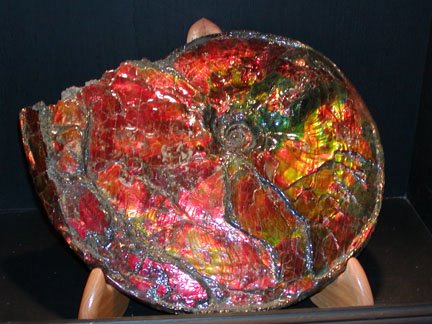
One thing I really liked was a giant fossil palm tree from Wyoming, but unfortunately the owners would not allow me to put a picture on my blog. You'll have to make do with this spectacular opalized ammonite from Alberta. The picture doesn't show the scale, but this thing is about the size of a laundry basket:


Gem quality opalized ammonite is known as "ammolite" in the trade, and there is a semi-secret procedure for stabilizing it and making it suitable for jewelry.

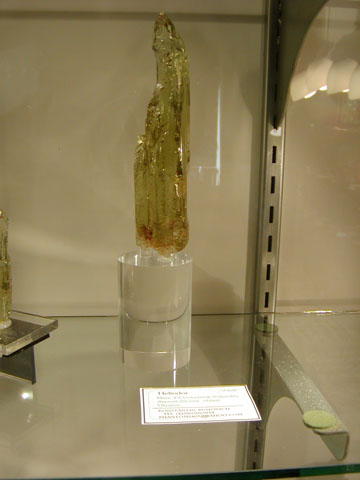
Of course, the InnSuites is not just fossils. Konstantin Buslovich of Phantom was selling this beautiful heliodor (a variety of beryl, the same family as aquamarine and emerald) from Ukraine, a steal at only $9300. Unfortunately I forgot to bring my $10,000 bill.


Outside the InnSuites, in a huge tent to the west, we found the Granada Avenue Mineral Show. A giant triceratops skull guards the entrance to the street. Here it is ferociously munching down on an unsuspecting van:


This show consisted of only five dealers, but one of them, Aurora Mineral Corp., had this really spectacular quartz geode, larger than a refrigerator:


This will be my last post from Tucson. Tomorrow I have to pack and get ready to head back home. Hope you enjoyed the trip as much as I did!

Saturday, February 04, 2006

Tucson - Day 4

For those who haven't been to the Tucson gem and mineral show, here's a brief description.

As I mentioned before, it's not just one show, it's actually dozens. There are shows devoted to fossils and minerals, shows for gemstones, jewelry shows, bead shows, and shows for native American artifacts. Some are retail, some are wholesale only, and some are a mixture of both. Although I've attended the show 3 times since 2002, I've still only visited a small portion of what there is to see.

Some shows take place in hotel rooms. The dealers sleep and display in the same room. When they wake up in the morning, the beds are made, personal items are put away, and the minerals come out. Many people display their minerals on the hotel room beds and tables, and some have displays on tables outside the room.

Other shows take place in the Tucson Convention Center, or in the large tent across the street.

Shows definitely have their own character. For example, among mineral shows, the one at the Westward Look is for very high end collectors, those that don't bat an eye at paying four or five figures or more for a single specimen. Below that in average specimen cost are the shows organized by Marty Zinn, at venues like the Inn Suites Hotel and Clarion. And even below that are the shows along the freeway, such as at the Howard Johnson's, and the show at Tucson Electric Park. Many dealers head for the cheaper shows to pick up items that they then resell for twice the price (or more) at their own shows.

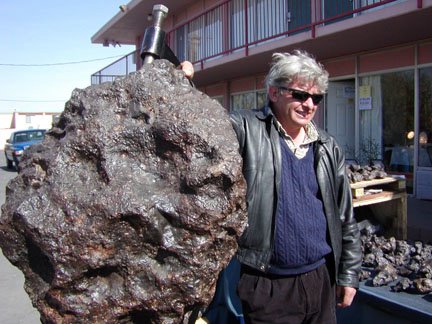
Here's an example. Among meteorite aficionados, the iron meteorites from Campo del Cielo in Argentina are held in low regard, in part because they are so common. They are probably the cheapest meteorites in price per gram. A dealer named "Giroldi" was selling them at the Howard Johnson's, with literally hundreds of specimens available. Here he is, posed with one of the largest pieces:


Later, I saw exactly the same meteorites for sale by meteorite dealers at the Inn Suites for twice the price. The lesson is that if you head down here, you might want to check out the cheaper shows first to see what the prices are.

I didn't spend much time at the show today. Instead, I went hiking with an old friend and colleague from Tucson.

It's been extremely dry here in the Southwest; the last significant precipitation in Tucson was almost a year ago. Normally Mt. Lemmon, to the north of Tucson, has a ski season, but not this year, since there is no snow.

We headed for the San Pedro River, the valley that is to the southeast of Tucson. This is an area that is famed for birding because it is one of the few places where there is running water. We got a late start, so we didn't see too many interesting birds. But I did notice how dry it was. Normally the cottonwoods would be much greener this time of year.

Friday, February 03, 2006

Tucson - Day 3 - Interview with Steve Smale


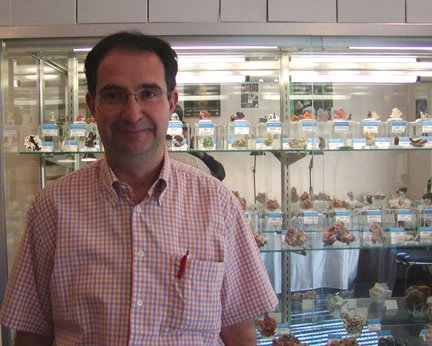
Stephen Smale is a world-famous mathematican and winner of the 1966 Fields Medal, mathematics' highest award. He's also a famous mineral collector, with one of the world's best private collections, and he has a new book coming out in April, featuring his collection. I had the chance to sit down with him this morning at his room at the Westward Look Resort and talk about politics, mathematics, and minerals. A Recursivity exclusive!

I've transcribed our discussion from a cassette tape. I've rearranged the discussion a bit, omitted some parts that were inaudible on the tape, and removed some others, but other than that, this transcription is more or less verbatim.

JOS: You were actively involved in protests against the Vietnam War at Berkeley. I'd like to know if you see any parallels between that time and now.

SS: Yeah, sure. Iraq has quite a bit of parallels with Vietnam.

JOS: Have you been moved to react in any manner?

SS: No, I'm not an activist these years. I was in a demo in Chicago, an anti-war vigil in Chicago, and I still have some activist friends. You know, a little bit. I'm not an activist, although my sympathies are with Cindy Sheehan.

JOS: I know that at one point you were working on your autobiography, and you completed a chapter or so. But then I came across the biography by Batterson. Do you still plan to work on an autobiography?

SS: No. With that book out, I don't think so. I published something called "Some autobiographical notes" - I think it's in my collected works. If it's not there, it's certainly in the volume for my 60th birthday. I think Batterson used those notes since they were already published when he wrote the book.

But after that book he's written... He really did a good job on it. He's very thorough, scholarly and accurate.

JOS: So, are you happy with the Batterson biography?

SS: Yes, I am. Especially from the point of view of being very accurate, careful, and documented. He doesn't in fact, indicate how careful he is. I mean, so many of his quotes are taken from taped interviews. He doesn't say that anywhere! He should, because people would then realize the authenticity of it. But, you know, the quotes are taken in general from taped interviews, and he has the tapes, so he has very thorough documentation. So from that point of view I think it's great.

In general. There's a couple of things that maybe... you know, he approached me like a mathematician in some sense. In some sense, I see myself a little more broadly as a scientist, not just a mathematician.

JOS: In the past, you've spoken enthusiastically about computer science and the challenges it brings to mathematics. Are you still enthusiastic along those lines?

SS: Yes, my main job is in a computer science institute.

JOS: Yes, at Toyota Technological Institute.

SS: Yes, that's the place, it was founded by computer scientists, it's a computer science institute.

But I do have a little different point of view from the computer science community. And I even have some conflicts with the computer science department at the University of Chicago and Toyota.

To oversimplify it, I come from the more continuous version of science and mathematics. Computer scientists tend to come from the discrete tradition. And you know, that brings us to some different points of view. My own conflict there is that the computer science department in which I am in is very narrowly focussed, in seeing so much of the science in terms of the discrete computer science tradition. So there have been some conflicts over hiring people.

I like to hire people that have a more deep mathematical perspective, not necessarily mathematicians, in fact not mathematicians, usually physicists who have a very good, sound training in mathematics. I wanted to hire this person to be an assistant professor, and I was voted down. So there are these kinds of conflicts. You know, I see myself criticizing the mathematics community and similarly the computer science community, and I think any similar community, as too much narrowly focussed around a tradition, and not understanding things happening outside of it.

JOS: I see that some of your latest work is on evolution of language, and also one of your open problems for the new century is on the limits of intelligence.

SS: That's the problem that I work on all the time now, for five years. We call it learning theory. It talks about the fundamental problems of intelligence and learning, both from the human and machine side. A lot has been happening in this area, called learning theory.

JOS: The limits of intelligence is a very deep problem. It's not going to have a quick solution.

SS: Right. (laughs) Right. But you know, learning theory is the closest part of a solid science dealing with both.

JOS: Since the word intelligence has come up, I can't resist asking your opinion of the intelligent design movement, if you've followed it at all.

SS: I don't follow it. You know, I'm pretty negative about it, about the religious basis of science. I don't pay much attention to it.

JOS: Let me ask you about electronic journals. That's a development that's happened in the last 10 years that's really grown. Do you think it's a positive development?

SS: Yeah. But I don't think of it too much in those terms. I just think in general the computer, the transmission of information via Internet, is a revolution, a change in the way one thinks about libraries and information and research. It affects me a huge amount. I don't hardly ever use libraries nowadays. I used to use libraries, 30 years ago, intensively. I used to just, you know, browse in libraries a huge amount. Now I browse on the Internet.

So I wouldn't want online journals to be the main focus. You need to think in the more broad sense. I use Google, not online journals. When I want to find something I want to learn about, I use Google. Sometimes Google, sometimes Google Scholar, sometimes other things, but I start with Google, type in a few keywords. So that's quite a revolutionary way of researching, doing research in science

JOS: Do you think that in the future it will be mostly preprint archives, with no refereeing process, and people decide the quality on their own, or is there still a place for peer review?

SS: (Laughs) Well, there's probably some place for peer review, yeah, I think there is. Getting some feedback is important. When I was young, peer-reviewed papers were the main method, and now. But it's been gradually happening, even before internet, preprints were more and more common, and finally internet. But you know, when I was a student, preprints were very rare.

JOS: Maybe we could turn to minerals now. Do you think being a mathematician influenced you strongly in becoming a mineral collector, or is it more or less coincidental?

SS: Oh, I don't know. I wouldn't say either. Maybe coincidental is closer. I don't believe much in coincidences, you know, there is a background. It started with Clara, and with my father, who bought me a mineral.

I don't see collecting as too close to mathematics. There is a kind of beauty I find in minerals, like I say in my new book, the beauty of natural crystals. So I support the beauty more than the scientific side. In my book I say, this is not a scientific book. It's not an art book either. But it's closer to an art book than a scientific book. And I don't follow the mathematics of crystallography.

JOS: Did you ever collect in the field?

SS: No, I never collect in the field. I've been in some mines. I don't purchase things so much, I trade.

JOS: On your website you say that in 1969 it was possible for a person of
moderate means to assemble a mineral collection that would rival those of museums. Do you think that's still true?

SS: Probably. Mineral museums don't really have the resources. Individuals have more money to spend each year for minerals than museums. Museums sometimes have endowed mineral collections, but if they're not careful, they get sold away. So, you know, you can compete with museums for minerals. Museums are occasionally endowed, like the one in Houston.

JOS: What do you think of that book, Masterpieces of the Mineral World?

SS: It's good, it's a good book. It's a very good book. Yeah. But you know, I have some issues with the book. First of all, it doesn't give enough credit to the main contributor, Jeff Scovil, in the book itself. So there was a big outcry about that and eventually they added something. The book itself just has a small mention, a note.

You know, our book is going to be a lot better as far as the processing of photographs. We do it in Germany, not in Asia. And we pay a lot more attention to processing the photo. I mean it's the difference between the Mineralogical Record. We have a picture there, you probably saw it, every month, every issue, which I think is not too good. Yeah, it's better than most magazines, but it's not nearly as good as extraLapis. You know extraLapis?

JOS: Yes.

SS: There they have a very, very good photograph reproduction, it's accurate. So our book is being published by extraLapis. Their first book, actually.

JOS: Congratulations.

SS: So we put a lot of effort into it. We've gone through each photograph from the printer this week, looking very carefully at the color tones and accuracy with the editors of extraLapis. It's something that has not been done with photographs in the Mineralogical Record. They're sloppy at the Mineralogical Record. I mean, they're better than most magazines.

Back to the Houston book, that did suffer because they didn't have the contrasting tones and accuracy, so the minerals don't stand out on the page. It's not bad, it's one of the best books. The best book is Bancroft, Gem and, uh.

JOS: Gem and Crystal Treasures.

SS: Yeah, I think that's the best book.

JOS: I notice that at shows, older people predominate. Do you think the hobby is dying?

SS: No, no, I don't think so. The big show here is dominated by younger people, in my opinion. At the shows, all the big names are young. Big dealers, big collectors. Stuart Wilensky, Rob Lavinsky. All the big dealers are young. They're driving the whole Internet market. I don't see too much of the people out on the floors at shows. I don't know if their age has changed. Certainly there are some aspects that younger people may not be interested in as much as they were 30 years ago. Rocks shops have been replaced by shows and the Internet. But I see many of the dealers, they're young, very forceful people. They're all in their 30's. Rob Lavinsky, he's probably 30 by now.

JOS: I know that for a while the Blue Cap tourmaline you were famous for was one of your favorites. What's one of your current favorites?

SS: It's not a question of a single piece. Phosphophyllite. Jeremejevite. Aquas and tourmalines are some of the best.

JOS: There's a nice phosphophyllite in the Masterpieces book.

SS: Yeah, it's good. I like ours quite a bit better, though. Theirs is restored. That's one reservation I have about their book, they put in repaired and restored pieces without saying they were repaired or restored.

When people are selling, they're better about it. But in the Masterpieces book, they should have said repaired or restored.

JOS: Thank you very much.

SS: Thank you.

Thursday, February 02, 2006

Tucson - Day 2

Still here in Tucson at the mineral and gem show.

I started this morning at the Smuggler's Inn, far on the east side of town. This show is dominated by the large number of foreign dealers, particularly from China and Russia. If you're looking for fluorite, wolframite, cinnabar, scheelite, or blue apatite, this is the place for you.

For me, some of the nicest specimens here were the large green fluorites from Hunan province. Here a gentleman from the Huanqiu Crystal Mineral Museum is holding one:


One of the nice things about the show is meeting people you've read about before in places like the Mineralogical Record. Here's the legendary Alfredo Petrov, a specialist in Bolivian minerals:


After a few hours at the Smuggler's, I went on to the Inn Suites. First, it was off to say hello to Richard Sittinger, who runs the Mineral of the Month Club. He seemed pretty busy!


Next, I stopped in to see Bill and Anne Cook of Virgin Valley Sales, who always have a large number of rare and unusual minerals for sale.


Now for the minerals. Here's a spectacular amazonite and smoky quartz from The Collector's Edge.


And here's a beautiful smithsonite from the same dealer:


Dilermando Rodrigues de Melo kindly posed with this amazing pink glassy kunzite from Minas Gerais:


And Vasconcelos Brazil had this spectacular large quartz cluster for sale. Note my cell phone at the lower left for scale.


Many meteorite dealers have rooms at the Inn Suites. Mike Farmer is one of the most famous meteorite hunters; he had a new lunar meteorite, which he kindly posed with:


Lunar meteorites are chunks of the moon that have been knocked off by an impact. They float around in space for a while and sometimes eventually hit the earth, but it takes a trained eye and laboratory analysis to recognize them (we know from the Apollo missions what moon rocks look like). And here's the meteorite by itself:


There was also a reception in honor of Steve Arnold, a meteorite hunter who found the new main mass of the Brenham, Kansas pallasite this fall. Here he is with this 640 kg specimen:


Pallasites are stony-iron meteorites that consist of olivine crystals floating in a matrix of iron-nickel. They are believed to be parts of asteroids where the mantle and core meet.

Signing off for now - more tomorrow.

Wednesday, February 01, 2006

Tucson - Day 1

I'm down in Tucson, Arizona, visiting the annual Tucson Gem and Mineral Show. Actually, it's several dozen different shows, each with many, many dealers selling rocks, minerals, gems, fossils, meteorites, jewellery, and more.

I'm really tired, because while I made a short connection at O'Hare yesterday, one of my bags didn't, so I ended up spending another two hours in the Phoenix airport waiting for it to catch up with me.

Today, I spent the whole day at one of the Arizona Mineral and Fossil Shows, at the Clarion Hotel on Alvernon. Lots of very beautiful minerals, most out of my price range! In fact, I'd like to title this day "in quest of the 6-figure specimen".

To start off with, this past summer there was a nice find of amethyst at Jackson's Crossroads in Wilkes County, Georgia, and they were available at Mountain Gems and Minerals. The color is really good, but as you can see, I'm still only at 4 figures.


Gold, of course, is always good for a nice price, and this native gold from Mineral Exploration Services at Lehigh Minerals is no exception. But we're still only at 4 figures.


Next, I was off to see Jordi Fabre at Fabre Minerals, one of Spain's premier dealers.


He had some really beautiful items, including this aquamarine in the high 4 figures.


Another nice piece was this rhodochrosite from the classic location of the Sweet Home Mine, from Isaias Casanova at IC Minerals. Amazing color!


To get to 5 figures, I went to Matrix India, where M. F. Makki had this really gigantic green apophyllite on stilbite from Momin Akhada, near Rahuri, Ahmednagar District, Maharashtra State, India. These deposits are often found when wells are being dug.


It's hard to tell from the photo, but this specimen is the size of a small refrigerator!

But to get to 6 figures, I had to go to Ausrox, where an amazing Pakistani aquamarine was on sale for $100,000. A little out of my price range!


Whew, all those expensive minerals have me exhausted. Now it's time to go see some rare ones.

The goal of the species collector is to have an example of every known mineral. Since there are more than 4,000 minerals currently known, with dozens of new ones found each year, this can be a real challenge. Luckily, at Tucson there are people to help.

Tony Nikischer runs Excalibur Mineral Corporation. He brought over 3100 different species to Tucson, and was kind enough to let me look through his flats of rare minerals. He also does mineral analysis, and edits Mineral News. There's even a mineral named after him! Here's his smiling face:


And another nice gentleman is Dr. Jaroslav Hyršl, co-author of the wonderful reference book Minerals and Their Localities. He's also got lots of rare species, mostly from Europe, and is very knowledgeable and friendly.


Well, that's all for today. Stay tuned, I may have some surprises later.