Yesterday I attended the second session about "healing prayer" conducted by University of Waterloo professor Clifford Blake. For my summary of Part I, see here.
The audience consisted of two other people and me, the token skeptic. Before the talk started, new rules were announced. No questions would be allowed during the talk. After the talk, one question each would be allowed. (I presume these rules were directed at me, based on the fact that I corrected several misstatements of fact in the previous talk.) These rules were quickly discarded, however, when the person who announced the rules herself asked a question in the middle of the talk.
In this session Professor Blake addressed "healing" methods recommended, as he understands it, in the Bible. He started by mentioning healings he has conducted at the University of Waterloo; he was interviewed about these healings by David Mainse of the Canadian religious TV program, "100 Huntley Street".
Most, if not all, religions have a holy book, Blake said. But, according to him, the Bible has been interpreted incorrectly. He made some disparaging remarks about current medical practice, and then stated that he doesn't appreciate it when hypotheses are presented to students as facts. (I think he was talking about the theory of evolution here, but he didn't elaborate.)
Genesis teaches us that God is a creator with infinitely more knowledge or intelligence than any human. We should try to be moral, holy, and just, just like God. (But I guess not infinite, like God. Because then there wouldn't be any room to move about.)
God has power and intelligence, so do we. If we are close to the Creator, we can create new body parts, too. (Now that's something I would like to see.)
Blake defined a miracle as "an unusual event with immediate impact".
God promised he would heal us (Exodus 15:26).
How was healing done in the Old Testament? Not everyone could do it. Men were prophets and had special gifts. As examples, he cited Elijah and Elisha. Leprosy was healed in 2nd Kings 5:10. And Elisha prayed that his servant's eyes would be opened to ; this is an example of intercession. (Blake said this was in 2nd Kings 17:21-22, but it actually seems to be 2nd Kings 6:17.)
Elijah interceded to have a child come back to life. This is an example of biblical healing - a prophet or man of God intercedes on behalf of someone else.
In the Old Testament, direct commands to heal are rare. In the New Testament, they are common.
Jesus has god-like qualities (sinless, etc.) This is how Christianity differs from other religions.
A true Christian can prevent other people from hitting them. Their opponent's arm will be unable to move. That's another unbelievable claim I'd like to see demonstrated!
In Luke 6:6 a man has a withered hand. In Luke 6:10 Jesus heals the hand. The command is issued directly to the affected part.
In Luke 4:33,35 a man is possessed by the spirit of an unclean demon. Today we would call such a person crazy. Jesus rebuked the demon and it was driven out.
Can disciples of Jesus do this kind of direct command? Yes, in Matthew 10:1. In John 14:12 it is said "You can do what I do and even greater." Yes, and in Mark 16:18 it is said that the true believer can drink any deadly thing without harm. Now that's another demonstration I'd like to see!
In Acts 3, Peter tells a man to get up and walk. This is not intercession, just a command.
Blake next discussed the Benson et al. study showing no effect of intercessory prayer, and laughed. "Come to my meetings and you will see miracles," he claimed.
Can everyone heal? Not necessarily - you have to receive power and authority from God.
Prayer causes changes, but not necessarily the ones that Benson et al. were measuring. I asked, how can you tell the difference between prayer causing no changes and prayer causing changes that cannot be measured. Prof. Blake replied that prayer could make the following kind of changes: a doctor that you weren't getting along with in the hospital could suddenly be re-assigned to another shift.
Healing comes when an individual has gift and authority and issues a command. Healing can even occur among non-believers, when it occurs as a sign of God's power. Blake said he had students who were Muslims and he healed them. He healed panic attacks in a Hindu, and he has healed Buddhists.
Most healings take place, however, when the healer has a gift. He said prayer and fasting could help: "Prayer and fasting are a Christian's daily bread." (I particularly enjoyed the image of fasting as bread; viewing not eating as eating.)
If you pray, you will see consistent results. (At this point I reminded Prof. Blake of his promise to bring evidence of his healings to this meeting. He replied that he said he would bring it, but not to this meeting. Maybe the next one?)
He gave another example of a woman he has healed. She was on life support in Toronto. He prayed for her and she went home from the hospital three days later.
A fellow with a "fractured knee" came to one of Prof. Blake's meetings on crutches. He walked out of the meeting without crutches.
Prob. Blake knows under what conditions healings occur. Faith works, but it can happen without. However, unbelief can block it.
At the conclusion of the meeting, I asked Prof. Blake (who wears glasses) why he didn't heal himself of poor vision. He replied that poor vision is a natural condition of old age, and so he has never tried. Besides, he said, healing himself doesn't work well, there is some kind of "short circuit" that prevents it. But he said he would try to heal himself of poor vision.
I was very disappointed not to hear about the "special recipe" of "herbs and oils" that one must "anoint" someone with to get healing, as Prof. Blake told me after the last session.
Citing Bible stories as facts and post hoc ergo propter hoc fallacies seemed to be the main arguments. Contradictory statements were given; healing can take place in the presence of unbelievers, but unbelief can block it, too. Needless to say, I was unimpressed.
Wednesday, January 17, 2007


Monday, January 15, 2007
J. Scott Turner Misses the Mark
J. Scott Turner, a professor at the SUNY College of Environmental Science & Forestry in Syracuse, New York, has a this dumb opinion piece in the January 19 2007 issue of the Chronicle of Higher Education. Since a subscription is required to read this (your university probably has a subscription), I'll excerpt a couple of the dumber remarks:
Also amusing is the spectacle of independent-minded scientists' running
to college administrators or the courts for help in defining what is
science and what is permissible discourse in their classrooms.
...
Faced with all that hue and cry, I almost want to say: "Friends,
intelligent design is just an idea."
...
The strain's very persistence invites the obvious question: If Darwin
settled the issue once and for all, why does it keep coming back?
Perhaps the fault lies with Darwin's supporters. Rather than debate the
strain on its merits, we scramble to the courts or the political
ramparts to expel it from our classrooms and our students' minds.
"Intelligent design" may be "just an idea", but ideas have consequences. Exactly the same could be said about racial inferiority, or national socialism, or totalitarian communism, or a number of other concepts -- they are "just ideas", too. * Being "just an idea" doesn't mean it doesn't have destructive consequences.
"Intelligent design" is a science stopper. Once something is explained as "designed" by a disembodied invisible "intelligence", we can proceed no further in our inquiry. Intelligent design proponents themselves state that science is not allowed to pursue the identity or motivation of the designer.
Turner's claim that scientists are "running to ... the courts for help in defining what is science" seems wildly off base. Is he really not aware that the issue in Dover, for example, was not "what is science", but whether intelligent design was essentially an endorsement of religion in the classroom? The 1st amendment doesn't even mention science. It wasn't scientists running to the court, but parents who don't want fundamentalist religion shoved down their children's throats.
Turner asks, "If Darwin settled the issue once and for all, why does it keep coming back?" The answer is obvious to me, but he doesn't even mention what is staring him in the face: the dominance and power of intolerant fundamentalist religion in North America. Evolution is a challenge to their beliefs. As James Watson wrote, "Today, the theory of evolution is an accepted fact for everyone but a fundamentalist minority, whose objections are based not on reasoning but on doctrinaire adherence to religious principles."
Turner's answer to his question is that scientists are at fault. But if this is true, he has to explain why the creationism issue virtually doesn't come up in places where fundamentalists have little power, such as Scandinavia. With Turner's reasoning, it must be that Scandinavian evolutionary biologists have some superior explanatory power over their North American colleagues. My explanation better fits the facts.
As for not debating the issue, exactly what does he think we have been doing? Has he read Mark Perakh's book, Unintelligent Design? Or Kenneth Miller's Finding Darwin's God? Or Why Intelligent Design Fails, where Wesley Elsberry and I contributed a chapter?
I'd give Professor Turner a C- for poor understanding of the issues.
* For the particularly dense reader let me state that I don't think that "intelligent design" has consequences as pernicious as those of the other ideas I listed. I give that list only to signal that saying something is "just an idea" is not terribly enlightening commentary.
Also amusing is the spectacle of independent-minded scientists' running
to college administrators or the courts for help in defining what is
science and what is permissible discourse in their classrooms.
...
Faced with all that hue and cry, I almost want to say: "Friends,
intelligent design is just an idea."
...
The strain's very persistence invites the obvious question: If Darwin
settled the issue once and for all, why does it keep coming back?
Perhaps the fault lies with Darwin's supporters. Rather than debate the
strain on its merits, we scramble to the courts or the political
ramparts to expel it from our classrooms and our students' minds.
"Intelligent design" may be "just an idea", but ideas have consequences. Exactly the same could be said about racial inferiority, or national socialism, or totalitarian communism, or a number of other concepts -- they are "just ideas", too. * Being "just an idea" doesn't mean it doesn't have destructive consequences.
"Intelligent design" is a science stopper. Once something is explained as "designed" by a disembodied invisible "intelligence", we can proceed no further in our inquiry. Intelligent design proponents themselves state that science is not allowed to pursue the identity or motivation of the designer.
Turner's claim that scientists are "running to ... the courts for help in defining what is science" seems wildly off base. Is he really not aware that the issue in Dover, for example, was not "what is science", but whether intelligent design was essentially an endorsement of religion in the classroom? The 1st amendment doesn't even mention science. It wasn't scientists running to the court, but parents who don't want fundamentalist religion shoved down their children's throats.
Turner asks, "If Darwin settled the issue once and for all, why does it keep coming back?" The answer is obvious to me, but he doesn't even mention what is staring him in the face: the dominance and power of intolerant fundamentalist religion in North America. Evolution is a challenge to their beliefs. As James Watson wrote, "Today, the theory of evolution is an accepted fact for everyone but a fundamentalist minority, whose objections are based not on reasoning but on doctrinaire adherence to religious principles."
Turner's answer to his question is that scientists are at fault. But if this is true, he has to explain why the creationism issue virtually doesn't come up in places where fundamentalists have little power, such as Scandinavia. With Turner's reasoning, it must be that Scandinavian evolutionary biologists have some superior explanatory power over their North American colleagues. My explanation better fits the facts.
As for not debating the issue, exactly what does he think we have been doing? Has he read Mark Perakh's book, Unintelligent Design? Or Kenneth Miller's Finding Darwin's God? Or Why Intelligent Design Fails, where Wesley Elsberry and I contributed a chapter?
I'd give Professor Turner a C- for poor understanding of the issues.
* For the particularly dense reader let me state that I don't think that "intelligent design" has consequences as pernicious as those of the other ideas I listed. I give that list only to signal that saying something is "just an idea" is not terribly enlightening commentary.
Saturday, January 13, 2007
The Phony War on Christmas Arrives in Waterloo
The new editor of our Faculty Association Newsletter, David Wang,
has fired the opening salvo (go to page 3 and read the editor's message). For those who don't feel like reading it in full, here's one of his remarks:
'I was recently in a local coffee shop that was decorated to the hilt but had only "Happy New Year" on its window. To say that this was annoying would be an understatement.'
Well, that make sense to me. I mean, who could disagree that it is the obligation of every coffee shop to honor the Christian religion? There's a law that says that every coffee shop must be decorated every December with tacky reindeer, elves, and tinsel, right? And be sure that the message "Merry Christmas" is displayed prominently, for the penalties are severe -- if you do not comply, then some patrons might be annoyed! None of this "Happy Holidays" or "Happy New Year" nonsense.
Strangely enough, though, there does not seem to be any similar obligation for coffee shops to celebrate Hanukkah. This is clearly unfair. Jews should demand that every coffee shop display a large, 5-foot, lighted dreidel.
Wang goes on to say,
'...in our society, freedom of religion increasingly is equated with absence of religion. This is a very dangerous trend.'
Again, who could disagree? What could be healthier for a society than that every religious believer -- be he Christian, Muslim, Jew, Sikh, or Hindu -- demand that his religion receive universal societal acclaim, and be annoyed when this does not occur? Why, that would never result in any violence, would it?
has fired the opening salvo (go to page 3 and read the editor's message). For those who don't feel like reading it in full, here's one of his remarks:
'I was recently in a local coffee shop that was decorated to the hilt but had only "Happy New Year" on its window. To say that this was annoying would be an understatement.'
Well, that make sense to me. I mean, who could disagree that it is the obligation of every coffee shop to honor the Christian religion? There's a law that says that every coffee shop must be decorated every December with tacky reindeer, elves, and tinsel, right? And be sure that the message "Merry Christmas" is displayed prominently, for the penalties are severe -- if you do not comply, then some patrons might be annoyed! None of this "Happy Holidays" or "Happy New Year" nonsense.
Strangely enough, though, there does not seem to be any similar obligation for coffee shops to celebrate Hanukkah. This is clearly unfair. Jews should demand that every coffee shop display a large, 5-foot, lighted dreidel.
Wang goes on to say,
'...in our society, freedom of religion increasingly is equated with absence of religion. This is a very dangerous trend.'
Again, who could disagree? What could be healthier for a society than that every religious believer -- be he Christian, Muslim, Jew, Sikh, or Hindu -- demand that his religion receive universal societal acclaim, and be annoyed when this does not occur? Why, that would never result in any violence, would it?
Wednesday, December 27, 2006
The Greatest Innovation of Theoretical Computer Science
Spiked magazine has asked me to contribute 200 words on the subject of the "greatest innovation in my field". Here's my answer:
In theoretical computer science, the greatest innovation is the realization that algorithms are mathematical objects, and can be rigorously analyzed in terms of their consumption of scarce resources, including space, time, and randomness.
One of the first to analyze an algorithm was the French mathematician Pierre-Joseph-Étienne Finck (1797-1870). In an 1841 book, he showed that the Euclidean algorithm for computing the greatest common divisor
of two integers uses a number of division steps that is linearly bounded in the number of digits of the inputs. Finck's work is all but forgotten today, but I discussed it in a paper in Historia Mathematica in 1994.
In recent times, much of the credit for the development of algorithm analysis certainly belongs to Donald Ervin Knuth (b. 1938), who in a series of books entitled The Art of Computer Programming, popularized many of the tools now used routinely to analyze algorithms. Almost overnight, algorithm analysis changed from a purely engineering approach involving coding and testing, to a rigorous branch of mathematics where the challenge is proving theorems.
In theoretical computer science, the greatest innovation is the realization that algorithms are mathematical objects, and can be rigorously analyzed in terms of their consumption of scarce resources, including space, time, and randomness.
One of the first to analyze an algorithm was the French mathematician Pierre-Joseph-Étienne Finck (1797-1870). In an 1841 book, he showed that the Euclidean algorithm for computing the greatest common divisor
of two integers uses a number of division steps that is linearly bounded in the number of digits of the inputs. Finck's work is all but forgotten today, but I discussed it in a paper in Historia Mathematica in 1994.
In recent times, much of the credit for the development of algorithm analysis certainly belongs to Donald Ervin Knuth (b. 1938), who in a series of books entitled The Art of Computer Programming, popularized many of the tools now used routinely to analyze algorithms. Almost overnight, algorithm analysis changed from a purely engineering approach involving coding and testing, to a rigorous branch of mathematics where the challenge is proving theorems.
Is Science the New Religion?
My local newspaper (and I use that term generously), the Kitchener-Waterloo Record, has reprinted this George Johnson article from the New York Times. The original headline, as given in the NYT, was "A Free-For-All on Science and Religion". But the Record chose to give it a different headline: "Could science be the new religion?"
Here's my response:
Dear Editor:
With regard to "Could science be the new religion?", Record, December
27, 2006:
I'll believe science is the new religion when
- we exchange gifts on Darwin's birthday
- we get a national holiday to commemorate the discovery of DNA
- scientists get the same access to the White House as Billy Graham does
- St. Mary's Hospital hangs pictures of Pasteur in all its rooms
- and the Record devotes as much space to science coverage as it
does to religion.
Until then, let's keep them separate.
Here's my response:
Dear Editor:
With regard to "Could science be the new religion?", Record, December
27, 2006:
I'll believe science is the new religion when
- we exchange gifts on Darwin's birthday
- we get a national holiday to commemorate the discovery of DNA
- scientists get the same access to the White House as Billy Graham does
- St. Mary's Hospital hangs pictures of Pasteur in all its rooms
- and the Record devotes as much space to science coverage as it
does to religion.
Until then, let's keep them separate.
Tuesday, December 19, 2006
My University Sponsors "Healing Prayer" Sessions
My university, the University of Waterloo, is sponsoring sessions on "healing prayer". Imagine my surprise!
Here are the details: our university has a Recreation Committee. Most of they events they sponsor are things like outings to the local ski hill, or ASL classes. However, they have also been sponsoring some more questionable events, featuring topics such as Reiki, therapeutic touch, and Feng Shui.
The most recent event was a session on "healing prayer". Here is how the session was described on the UW Recreation Committee (UWRC) web site, until recently:
Monday, December 18, 2006: "Life Series" - Healing Prayer with Dr. Clifford Blake (First of Five Lessons). Humans have battled sickness, disease and calamity as long as they have been on earth. Lesson 1: A survey of some spiritual healing methods. An opportunity will be given to share experiences. Cost: no charge.
Oddly enough, although the talk has since vanished from the UWRC web site, the first session was still held yesterday. (I have been trying to find out from the UWRC why the talk descriptions have vanished. So far, no reply.)
Reader, I ask you to look at my summary of what Prof. Blake said in his talk, and tell me, is this the kind of talk our university should be sponsoring? (My comments below are in red.)
First, some background. The speaker, Clifford Blake, is a professor in the Department of Management Sciences. According to this page, Prof. Blake "has counselling ministries in spiritual and psycho-social development, and the empowerment of individuals, with a special focus on youths. He is actively involved in preaching, teaching and counselling in his local church and currently operates an independent counselling and healing ministry. At the community level Dr. Blake presents seminars on Black History and the African Genetic root, based on a synthesis of Holy Scripture, DNA research findings and fossil discoveries."
He began by stating his talk would be based on his scientific and religious background. Prayer, he said, has been used for thousands of years to overcome difficulties. But it hasn't been used as Biblical teachings prescribe, and so the results haven't been as good as they could be. He spoke of his own ministry and testimonials about healings. A man who had cancer, he said, was healed through a combination of chemotherapy and his healing methods. It was the combination of all, he asserted, that resulted in the cure. He advocated "magnetic methods" and "energy methods"; combining them is more efficacious.
He cautioned that traditional methods [by this he evidently meant conventional medicine] are excellent when it comes to analysis, but one shouldn't take them without question. Get other opinions: what are the side effects?
He then asked for testimonials from the audience. One participant advocated "Kriya Yoga" as "the fastest way to God". The miracles that she witnessed "could fill volumes". Someone who had Parkinson's is now almost symptom-free. A woman she knew had a stroke and was mostly paralyzed, but thanks to Kriya Yoga, she has now recovered. Additional examples were given.
Another participant discussed her experience being on a local bus where the bus engine died. She prayed, she said, and the bus engine then started up. When you put you hand on someone and pray, you can feel electricity.
Prof. Blake discussed other examples of healings he has participated in. A person at the university with a relative with obsessive-compulsive disorder was "completely cured" after one month visiting with Prof. Blake. A student with
"fractured legs" was able to walk "immediately" after being touched by Blake. He acknowledged that he could not prove he was responsible for the healing, but "if someone has a chronic condition for many years, and improves after my sessions, then that's pretty good evidence". A woman has x-rays before and after proving that a fracture was miraculously healed. He can bring letters from a woman in British Columbia who had leukemia; after he gave her a prayer in a letter, she was healed.
Prof. Blake then said he did not counsel people to not go to doctors. He then discussed "facts": drug companies keep their side effects a secret. For example, he said a recent study in the US showed breast cancer was down because women had decreased their estrogen replacement therapy. He had a relative who died of breast cancer after taking this therapy.
He then asked, what is the 3rd highest cause of death in the US. It is "iatrogenic causes" [meaning caused unintentionally by a physician]. A study in JAMA, he said, listed 225,000 deaths a year come from these causes, including 12,000 deaths from surgery, 7,000 deaths from medication, 80,000 from nosocomial infections, and 106,000 from "non-error adverse effects". He then asserted that these figures are "restricted information" and is "not published in general". He claimed that in order to read this study, he had to state he was "Dr. Blake" in order to get to the web site, because it was only available to doctors and not to the general public. A participant from the audience stated that the results of such a study would never be published in the local paper, the Kitchener-Waterloo Record.
[The claim about "restricted information" is false. There was no need for Prof. Blake to represent himself as "Dr. Blake" in order to gain access, as our university has a subscription to JAMA (the Journal of the American Medical Association), which is available for free to all members of the university community. In a few minutes, I was able to find the "study" Prof. Blake was referring to. It is not a study, but a "commentary" by Barbara Starfield [JAMA, Vol. 284, No. 4 (2000), 483-485] that discusses a study, "To Err is Human", published by the Institute of Medicine in 1999. Contrary to Prof. Blake's assertion that this was "restricted information" and the participant's claim that the results would not be published in our local paper, I was able in a just a few minutes to find dozens of references to the study in mainstream media, including one in our local newspaper.]
Prof. Blake then went to discuss his sister, who died "because she had diabetes and her liver was irreversibly damaged from medication".
He then discussed results on acupuncture: 50-90% report relief. Tai Chi is also useful.
He cited a study that said religious practices are useful in lowering depression [Braam, Psychological Medicine V. 31 No. 5 (2001), 803-814]. He talked again about "energy" and I asked what he meant by energy.
Prof. Blake stated that energy is a "wave pattern" that makes up our bodies. When we are sick, it is because our organs are "not vibrating at the frequency they were designed to operate at". Doctors are working on that, he alleged. The laying on of hands works because it "corrects malfunctioning energy". But you can't always tell if healing works, because according to the uncertainty principle, introducing a measurement changes the way the system operates.
He described a man with severe knee problems that he saw. The man came in with a cane, Prof. Blake laid hands on him and said a benediction, and the man walked out without his cane. People live healthier lives with religion.
Audience members asserted that "drug companies were only interested in profits".
Prof. Blake asserted that "Einstein was a very religious person" and "wanted scientists to become more religious".
[ I pointed out that what Einstein meant by religion was not what most people meant. For example, Einstein said in a 1954 letter, "It was, of course, a lie what you read about my religious convictions, a lie which is being systematically repeated. I do not believe in a personal God and I have never denied this but have expressed it clearly. If something is in me which can be called religious then it is the unbounded admiration for the structure of the world so far as our science can reveal it."]
Prof. Blake concluded by saying in the next session, he would discuss how prayers can be more effective and how you can get more consistent results from prayers. In my informal talk with him after the sessions, he asserted that this was due to his special recipe for herbs and oils that one must anoint someone with in order to heal, and the fact that only specially gifted people (presumably Prof. Blake is one of them) have the power to heal.
Here are the details: our university has a Recreation Committee. Most of they events they sponsor are things like outings to the local ski hill, or ASL classes. However, they have also been sponsoring some more questionable events, featuring topics such as Reiki, therapeutic touch, and Feng Shui.
The most recent event was a session on "healing prayer". Here is how the session was described on the UW Recreation Committee (UWRC) web site, until recently:
Monday, December 18, 2006: "Life Series" - Healing Prayer with Dr. Clifford Blake (First of Five Lessons). Humans have battled sickness, disease and calamity as long as they have been on earth. Lesson 1: A survey of some spiritual healing methods. An opportunity will be given to share experiences. Cost: no charge.
Oddly enough, although the talk has since vanished from the UWRC web site, the first session was still held yesterday. (I have been trying to find out from the UWRC why the talk descriptions have vanished. So far, no reply.)
Reader, I ask you to look at my summary of what Prof. Blake said in his talk, and tell me, is this the kind of talk our university should be sponsoring? (My comments below are in red.)
First, some background. The speaker, Clifford Blake, is a professor in the Department of Management Sciences. According to this page, Prof. Blake "has counselling ministries in spiritual and psycho-social development, and the empowerment of individuals, with a special focus on youths. He is actively involved in preaching, teaching and counselling in his local church and currently operates an independent counselling and healing ministry. At the community level Dr. Blake presents seminars on Black History and the African Genetic root, based on a synthesis of Holy Scripture, DNA research findings and fossil discoveries."
He began by stating his talk would be based on his scientific and religious background. Prayer, he said, has been used for thousands of years to overcome difficulties. But it hasn't been used as Biblical teachings prescribe, and so the results haven't been as good as they could be. He spoke of his own ministry and testimonials about healings. A man who had cancer, he said, was healed through a combination of chemotherapy and his healing methods. It was the combination of all, he asserted, that resulted in the cure. He advocated "magnetic methods" and "energy methods"; combining them is more efficacious.
He cautioned that traditional methods [by this he evidently meant conventional medicine] are excellent when it comes to analysis, but one shouldn't take them without question. Get other opinions: what are the side effects?
He then asked for testimonials from the audience. One participant advocated "Kriya Yoga" as "the fastest way to God". The miracles that she witnessed "could fill volumes". Someone who had Parkinson's is now almost symptom-free. A woman she knew had a stroke and was mostly paralyzed, but thanks to Kriya Yoga, she has now recovered. Additional examples were given.
Another participant discussed her experience being on a local bus where the bus engine died. She prayed, she said, and the bus engine then started up. When you put you hand on someone and pray, you can feel electricity.
Prof. Blake discussed other examples of healings he has participated in. A person at the university with a relative with obsessive-compulsive disorder was "completely cured" after one month visiting with Prof. Blake. A student with
"fractured legs" was able to walk "immediately" after being touched by Blake. He acknowledged that he could not prove he was responsible for the healing, but "if someone has a chronic condition for many years, and improves after my sessions, then that's pretty good evidence". A woman has x-rays before and after proving that a fracture was miraculously healed. He can bring letters from a woman in British Columbia who had leukemia; after he gave her a prayer in a letter, she was healed.
Prof. Blake then said he did not counsel people to not go to doctors. He then discussed "facts": drug companies keep their side effects a secret. For example, he said a recent study in the US showed breast cancer was down because women had decreased their estrogen replacement therapy. He had a relative who died of breast cancer after taking this therapy.
He then asked, what is the 3rd highest cause of death in the US. It is "iatrogenic causes" [meaning caused unintentionally by a physician]. A study in JAMA, he said, listed 225,000 deaths a year come from these causes, including 12,000 deaths from surgery, 7,000 deaths from medication, 80,000 from nosocomial infections, and 106,000 from "non-error adverse effects". He then asserted that these figures are "restricted information" and is "not published in general". He claimed that in order to read this study, he had to state he was "Dr. Blake" in order to get to the web site, because it was only available to doctors and not to the general public. A participant from the audience stated that the results of such a study would never be published in the local paper, the Kitchener-Waterloo Record.
[The claim about "restricted information" is false. There was no need for Prof. Blake to represent himself as "Dr. Blake" in order to gain access, as our university has a subscription to JAMA (the Journal of the American Medical Association), which is available for free to all members of the university community. In a few minutes, I was able to find the "study" Prof. Blake was referring to. It is not a study, but a "commentary" by Barbara Starfield [JAMA, Vol. 284, No. 4 (2000), 483-485] that discusses a study, "To Err is Human", published by the Institute of Medicine in 1999. Contrary to Prof. Blake's assertion that this was "restricted information" and the participant's claim that the results would not be published in our local paper, I was able in a just a few minutes to find dozens of references to the study in mainstream media, including one in our local newspaper.]
Prof. Blake then went to discuss his sister, who died "because she had diabetes and her liver was irreversibly damaged from medication".
He then discussed results on acupuncture: 50-90% report relief. Tai Chi is also useful.
He cited a study that said religious practices are useful in lowering depression [Braam, Psychological Medicine V. 31 No. 5 (2001), 803-814]. He talked again about "energy" and I asked what he meant by energy.
Prof. Blake stated that energy is a "wave pattern" that makes up our bodies. When we are sick, it is because our organs are "not vibrating at the frequency they were designed to operate at". Doctors are working on that, he alleged. The laying on of hands works because it "corrects malfunctioning energy". But you can't always tell if healing works, because according to the uncertainty principle, introducing a measurement changes the way the system operates.
He described a man with severe knee problems that he saw. The man came in with a cane, Prof. Blake laid hands on him and said a benediction, and the man walked out without his cane. People live healthier lives with religion.
Audience members asserted that "drug companies were only interested in profits".
Prof. Blake asserted that "Einstein was a very religious person" and "wanted scientists to become more religious".
[ I pointed out that what Einstein meant by religion was not what most people meant. For example, Einstein said in a 1954 letter, "It was, of course, a lie what you read about my religious convictions, a lie which is being systematically repeated. I do not believe in a personal God and I have never denied this but have expressed it clearly. If something is in me which can be called religious then it is the unbounded admiration for the structure of the world so far as our science can reveal it."]
Prof. Blake concluded by saying in the next session, he would discuss how prayers can be more effective and how you can get more consistent results from prayers. In my informal talk with him after the sessions, he asserted that this was due to his special recipe for herbs and oils that one must anoint someone with in order to heal, and the fact that only specially gifted people (presumably Prof. Blake is one of them) have the power to heal.
Tuesday, December 12, 2006
Skeptics Canada Opens an Office
I just received some good news in an e-mail message from Skeptics Canada: they are going to open an office in Toronto starting on January 1, 2007. The office will be at 873 Broadview Avenue, just north of Danforth. This is a great step forward for organized skepticism in Canada. If you're interested in fighting against irrationality in all its forms, consider joining Skeptics Canada.
Friday, December 01, 2006
The Prime Game
First, the game.
Ask a friend to write down a prime number. Bet them that you can always strike out 0 or more digits to get one of the following 26 primes:
2, 3, 5, 7, 11, 19, 41, 61, 89, 409, 449, 499, 881, 991, 6469, 6949, 9001, 9049, 9649, 9949, 60649, 666649, 946669, 60000049, 66000049, 66600049.
For example, if your friend writes down 43, you can strike out the 4 to get 3. If your friend writes down 946969, you can strike out the first 9 and the 6's to get 499.
(There's not always a unique way to do this, and of course it works with some non-primes, too: if your friend writes down 35, which isn't a prime, you can strike out the 3 to get 5 or vice versa. But if someone gives you a number where you can't strike out some subset of the digits to get a prime on the list above, then that number isn't prime. For example, you can't strike out any subset of the digits of 649 to get a prime on the list, but 649 isn't prime.)
I published this strange result in the Journal of Recreational Mathematics in 2000; there's a copy on my papers page. Believe it or not, there's actually some interesting mathematics behind it.
Let's say that a string of symbols x is a subsequence of a string of symbols y if you can strike out some symbols of y (not necessarily contiguous) to get x. ("Subsequence" seems to be the preferred term in North America, but in Europe they call this a "subword". However "subword" is used in North America to mean "contiguous subblock".) The relation "x is a subsequence of y" is a partial order, meaning it shares the following properties of the ordinary <= relation on integers:
We now call two strings comparable if x is a subsequence of y, or vice versa; otherwise, we say x and y are incomparable. A set is pairwise incomparable if every pair of elements is incomparable.
Now, a very neat result about the subsequence partial order is that every pairwise incomparable set is finite. This isn't obvious, and it isn't true for every partial order. (For example, it isn't true for the order where "subsequence" is replaced by "subword".) You may enjoy trying to prove this.
We need one more concept: the minimal element. A string x in S is said to be minimal for S if whenever y in S is a subsequence of x, then y=x. Given a set of strings S, it's not hard to see that the set of minimal elements of S is pairwise incomparable. So it must be finite. And every string in S has the property that some minimal element is a subsequence of it.
Now, to get the prime game, let S be the set of strings representing primes in base 10. The list of 26 primes above is the set of minimal elements for S.
Determining the set of minimal elements isn't always easy. For example, if instead of the primes we use the decimal representations of the powers of 2, then no one currently knows how to compute the set of minimal elements. It's probably {1,2,4,8,65536}, but proving this seems quite hard.
A neat consequence of this result is that, given any language L, the set of all subsequences of strings in L is regular. We can't always easily determine the regular expression or automaton for L, but we know it exists.
Here's a link to a file of cards you can print, cut out, and perhaps laminate, with the prime game on them. Enjoy.
Ask a friend to write down a prime number. Bet them that you can always strike out 0 or more digits to get one of the following 26 primes:
2, 3, 5, 7, 11, 19, 41, 61, 89, 409, 449, 499, 881, 991, 6469, 6949, 9001, 9049, 9649, 9949, 60649, 666649, 946669, 60000049, 66000049, 66600049.
For example, if your friend writes down 43, you can strike out the 4 to get 3. If your friend writes down 946969, you can strike out the first 9 and the 6's to get 499.
(There's not always a unique way to do this, and of course it works with some non-primes, too: if your friend writes down 35, which isn't a prime, you can strike out the 3 to get 5 or vice versa. But if someone gives you a number where you can't strike out some subset of the digits to get a prime on the list above, then that number isn't prime. For example, you can't strike out any subset of the digits of 649 to get a prime on the list, but 649 isn't prime.)
I published this strange result in the Journal of Recreational Mathematics in 2000; there's a copy on my papers page. Believe it or not, there's actually some interesting mathematics behind it.
Let's say that a string of symbols x is a subsequence of a string of symbols y if you can strike out some symbols of y (not necessarily contiguous) to get x. ("Subsequence" seems to be the preferred term in North America, but in Europe they call this a "subword". However "subword" is used in North America to mean "contiguous subblock".) The relation "x is a subsequence of y" is a partial order, meaning it shares the following properties of the ordinary <= relation on integers:
- x is a subsequence of x;
- If x is a subsequence of y and y is a subsequence of x, then x=y.
- If x is a subsequence of y and y is a subsequence of z, then x is a subsequence of z.
We now call two strings comparable if x is a subsequence of y, or vice versa; otherwise, we say x and y are incomparable. A set is pairwise incomparable if every pair of elements is incomparable.
Now, a very neat result about the subsequence partial order is that every pairwise incomparable set is finite. This isn't obvious, and it isn't true for every partial order. (For example, it isn't true for the order where "subsequence" is replaced by "subword".) You may enjoy trying to prove this.
We need one more concept: the minimal element. A string x in S is said to be minimal for S if whenever y in S is a subsequence of x, then y=x. Given a set of strings S, it's not hard to see that the set of minimal elements of S is pairwise incomparable. So it must be finite. And every string in S has the property that some minimal element is a subsequence of it.
Now, to get the prime game, let S be the set of strings representing primes in base 10. The list of 26 primes above is the set of minimal elements for S.
Determining the set of minimal elements isn't always easy. For example, if instead of the primes we use the decimal representations of the powers of 2, then no one currently knows how to compute the set of minimal elements. It's probably {1,2,4,8,65536}, but proving this seems quite hard.
A neat consequence of this result is that, given any language L, the set of all subsequences of strings in L is regular. We can't always easily determine the regular expression or automaton for L, but we know it exists.
Here's a link to a file of cards you can print, cut out, and perhaps laminate, with the prime game on them. Enjoy.
Sunday, November 19, 2006
The PEAR Has Finally Rotted
From the November 8 Princeton Alumni Weekly comes the welcome news that PEAR, the Princeton Engineering Anomalies Research laboratory, is closing.
Don't be fooled by the fancy name. "Engineering Anomalies" is just a fancy name for good-old-fashioned parapsychology. PEAR's director, Robert Jahn, has been trying to show psychic phenomena are real ever since I was an undergraduate. But with funding reportedly drying up on his unsuccessful efforts, PEAR could no longer be sustained.
PEAR has been an embarrassment to Princeton alumni since day one. Jahn and colleagues never succeeded in demonstrating any significant effect; one of the strongest results they claimed was an 0.02% advantage in coin flipping. Other claimed results, such as the ones dealing with "remote viewing", have been criticized for sloppy experiment design. And to my knowledge no one has succeeded in replicating their results. Jahn claims "it has been the most personally stimulating and rewarding intellectual activity I've ever been involved in". Pitiful.
Don't be fooled by the fancy name. "Engineering Anomalies" is just a fancy name for good-old-fashioned parapsychology. PEAR's director, Robert Jahn, has been trying to show psychic phenomena are real ever since I was an undergraduate. But with funding reportedly drying up on his unsuccessful efforts, PEAR could no longer be sustained.
PEAR has been an embarrassment to Princeton alumni since day one. Jahn and colleagues never succeeded in demonstrating any significant effect; one of the strongest results they claimed was an 0.02% advantage in coin flipping. Other claimed results, such as the ones dealing with "remote viewing", have been criticized for sloppy experiment design. And to my knowledge no one has succeeded in replicating their results. Jahn claims "it has been the most personally stimulating and rewarding intellectual activity I've ever been involved in". Pitiful.
Saturday, November 18, 2006
Innumeracy in the Record
From the Kitchener-Waterloo Record, Friday, November 17, 2006,
page C1:
"Thirty years later, I've now written a newspaper column every week, 52 weeks a year, a total of 5,230 articles. It's an experience I wouldn't have missed. And what have I learned?"
Clearly not multiplication.
page C1:
"Thirty years later, I've now written a newspaper column every week, 52 weeks a year, a total of 5,230 articles. It's an experience I wouldn't have missed. And what have I learned?"
Clearly not multiplication.
Thursday, November 16, 2006
Higher Education at Conestoga College
Conestoga College is a community college based in Kitchener and three surrounding communities. They offer a large variety of useful courses in electronics, business, and other subjects.
Unfortunately, they also offer several courses that don't belong at a community college. These courses, as described in the Conestoga College catalogue for Winter 2007, make truth claims about ESP, psychic powers, astral projections, auras, and homeopathy that have no factual basis. I would not object to a course exploring these topics provided no truth claims were made. For example, a course carefully examining the evidence for and against psychic powers would be welcome. These courses apparently don't do that. Here are the descriptions:
Homeopathic Medicine - An Introduction
This 200-year-old system of healing is based on the principles of "like cures like", using tiny doses of plant, animal and mineral substances to stimulate the body to recover its balance. Learn about the philosophy and history of homeopathic medicine and the top 10 remedies homeopathy has to offer.
The Psychic World
This one-day seminar will help you to develop the dynamic powers of your mind. The course will cover such topics as E.S.P. games to increase your own abilities, learn how to meditate, how to see auras and decipher what the colours mean. We will discuss how to interpret your dreams and control them, Astral projection and more.
Advanced Psychic World
Advanced Psychic World continues where 'The Psychic World' left off. It will cover such topics as: alternative realities, ley lines, other styles of meditation, and astral projection. The class will be taken on two group projections. Students will need to bring a blanket and pillow.
Reincarnation - Who Were You?
This one-day workshop explores the possibility of past lives and what karma is. It gives some very interesting theories as to why bad things do happen to good people and why you are where you are today. This class also includes three group past-life regressions which may help the students to remember their previous lives. A blanket and pillow is needed for this class. The students should wear loose-fitting, comfortable clothing.
Why is Conestoga College sponsoring such nonsense? Who is in charge of approving the curriculum and how did these courses get approved? Call Conestoga College President John Tibbits at (519) 748-5220 and ask. Or send him e-mail at jtibbits@conestogac.on.ca. At the very least, Conestoga College should add a disclaimer to their catalogue saying that they do not endorse this pseudoscience.
Unfortunately, they also offer several courses that don't belong at a community college. These courses, as described in the Conestoga College catalogue for Winter 2007, make truth claims about ESP, psychic powers, astral projections, auras, and homeopathy that have no factual basis. I would not object to a course exploring these topics provided no truth claims were made. For example, a course carefully examining the evidence for and against psychic powers would be welcome. These courses apparently don't do that. Here are the descriptions:
Homeopathic Medicine - An Introduction
This 200-year-old system of healing is based on the principles of "like cures like", using tiny doses of plant, animal and mineral substances to stimulate the body to recover its balance. Learn about the philosophy and history of homeopathic medicine and the top 10 remedies homeopathy has to offer.
The Psychic World
This one-day seminar will help you to develop the dynamic powers of your mind. The course will cover such topics as E.S.P. games to increase your own abilities, learn how to meditate, how to see auras and decipher what the colours mean. We will discuss how to interpret your dreams and control them, Astral projection and more.
Advanced Psychic World
Advanced Psychic World continues where 'The Psychic World' left off. It will cover such topics as: alternative realities, ley lines, other styles of meditation, and astral projection. The class will be taken on two group projections. Students will need to bring a blanket and pillow.
Reincarnation - Who Were You?
This one-day workshop explores the possibility of past lives and what karma is. It gives some very interesting theories as to why bad things do happen to good people and why you are where you are today. This class also includes three group past-life regressions which may help the students to remember their previous lives. A blanket and pillow is needed for this class. The students should wear loose-fitting, comfortable clothing.
Why is Conestoga College sponsoring such nonsense? Who is in charge of approving the curriculum and how did these courses get approved? Call Conestoga College President John Tibbits at (519) 748-5220 and ask. Or send him e-mail at jtibbits@conestogac.on.ca. At the very least, Conestoga College should add a disclaimer to their catalogue saying that they do not endorse this pseudoscience.
Wednesday, November 08, 2006
Some of the Bums are Gone
Well, sanctimonious prig Joe Lieberman is still around. And Orrin Hatch, of course was never in doubt. Jon Kyl easily won re-election.
But hard-core culture warrior Rick Santorum -- the man whose last name has now become a synonym for disgusting -- is gone. Don't let the door hit you on your way out, Rick.
George Allen is currently trailing by about 8,000 votes. But I wouldn't be surprised if the Republicans find a way to steal this one.
Discovery Institute shill Deborah Owens Fink lost bigtime.
All in all, it's a pretty good election. Science won. Fundamentalists lost.
But hard-core culture warrior Rick Santorum -- the man whose last name has now become a synonym for disgusting -- is gone. Don't let the door hit you on your way out, Rick.
George Allen is currently trailing by about 8,000 votes. But I wouldn't be surprised if the Republicans find a way to steal this one.
Discovery Institute shill Deborah Owens Fink lost bigtime.
All in all, it's a pretty good election. Science won. Fundamentalists lost.
Tuesday, November 07, 2006
Throw the Bums Out!
If you're an American citizen, as I am, you can't help but be appalled by what's been going on in Washington lately.
Instead of addressing serious issues such as global warming, the Republican-led Congress has been on a hate-filled crusade against gay marriage.
Instead of trying to find a solution to the mess in Iraq, our clueless Commander-in-Chief is repeating "Stay the course" as if it were his own private mantra.
Instead of adequately funding stem-cell research, Republicans have been attempting to suppress it in the name of their love affair with the embryo.
Instead of trying to fix a broken voting system, Republicans have been intimidating voters, throwing legitimate voters off the rolls, and pushing defective voting machines.
It's time to throw the bums out. No, not every Republican is corrupt, and not every Democrat is a paragon of virtue. I won't feel bad if smug and pious Harold Ford fails to get elected. But here's my own private list of politicians that have to go.
#1: Rick Santorum: This anti-gay bigot is an embarrassment to Pennsylvania, the state of my birth. He's also claimed that intelligent design is a legitimate scientific theory that should be taught in science classes. His opponent, Bob Casey, is an opponent of abortion rights, but he'd be better than the vile Santorum.
#2: Orrin Hatch: He tries to look statesmanlike, but deep down he's a wingnut. He's an anti-gay bigot because "It's a religious belief to me that homosexuality flies in the face of biblical teachings." He supported the nomination of far-right Alabama attorney general Bill Pryor for the federal bench.
#3: Jon Kyl: Kyl has consistently voted against environmental protections. He's against abortion and stem-cell research. He opposed the chemical weapons treaty. I don't think his opponent, Jim Pederson, has much of a chance, but we can hope, right?
#4: Deborah Owens Fink: No, she's not in Washington, but this member of the Ohio school board has been pushing the pseudoscience of intelligent design in Ohio schools. She claims that evolution is "indoctrinated" in schools but has refused to provide any evidence of that claim.
#5: Joe Lieberman: If you look up "sanctimonious prig" in the dictionary, it says "see Lieberman, Joe". Failed to win the Democratic nomination, so instead of taking his licks like a man, he ran as an independent. Then had the temerity to claim "I didn't choose to run as an independent." Who did, then, Joe?
#6: George Allen: Let's see: Confederate flag lover, caster of a racial slur against an American of Indian descent, bizarre reaction when he learned he was Jewish, racial slurs as an undergraduate... What's not to like? And his campaign against Jim Webb has been worse than despicable.
So, get out and vote, and vote against these creeps.
Instead of addressing serious issues such as global warming, the Republican-led Congress has been on a hate-filled crusade against gay marriage.
Instead of trying to find a solution to the mess in Iraq, our clueless Commander-in-Chief is repeating "Stay the course" as if it were his own private mantra.
Instead of adequately funding stem-cell research, Republicans have been attempting to suppress it in the name of their love affair with the embryo.
Instead of trying to fix a broken voting system, Republicans have been intimidating voters, throwing legitimate voters off the rolls, and pushing defective voting machines.
It's time to throw the bums out. No, not every Republican is corrupt, and not every Democrat is a paragon of virtue. I won't feel bad if smug and pious Harold Ford fails to get elected. But here's my own private list of politicians that have to go.
#1: Rick Santorum: This anti-gay bigot is an embarrassment to Pennsylvania, the state of my birth. He's also claimed that intelligent design is a legitimate scientific theory that should be taught in science classes. His opponent, Bob Casey, is an opponent of abortion rights, but he'd be better than the vile Santorum.
#2: Orrin Hatch: He tries to look statesmanlike, but deep down he's a wingnut. He's an anti-gay bigot because "It's a religious belief to me that homosexuality flies in the face of biblical teachings." He supported the nomination of far-right Alabama attorney general Bill Pryor for the federal bench.
#3: Jon Kyl: Kyl has consistently voted against environmental protections. He's against abortion and stem-cell research. He opposed the chemical weapons treaty. I don't think his opponent, Jim Pederson, has much of a chance, but we can hope, right?
#4: Deborah Owens Fink: No, she's not in Washington, but this member of the Ohio school board has been pushing the pseudoscience of intelligent design in Ohio schools. She claims that evolution is "indoctrinated" in schools but has refused to provide any evidence of that claim.
#5: Joe Lieberman: If you look up "sanctimonious prig" in the dictionary, it says "see Lieberman, Joe". Failed to win the Democratic nomination, so instead of taking his licks like a man, he ran as an independent. Then had the temerity to claim "I didn't choose to run as an independent." Who did, then, Joe?
#6: George Allen: Let's see: Confederate flag lover, caster of a racial slur against an American of Indian descent, bizarre reaction when he learned he was Jewish, racial slurs as an undergraduate... What's not to like? And his campaign against Jim Webb has been worse than despicable.
So, get out and vote, and vote against these creeps.
Wednesday, September 27, 2006
A Tale of Two Conferences
Recently I learned about two academic conferences. The constrast between them is rather striking, and illustrates the way in which evolution is legitimate, mainstream science, while intelligent design is pseudoscience.
The first conference is the IEEE Congress on Evolutionary Computation (CEC), to be held in Singapore in September 2007. The second is The God Hypothesis: Has Science Found God?, to take place this coming weekend at the University of Toronto, here in Ontario.
CEC will represent real science. Its international advisory board includes accomplished experts in the field, such as David Fogel. It is in the tradition of other, similar conferences, and is sponsored by the IEEE, one of the largest professional organizations of computer scientists. Evolutionary computation is an active area of academic study, in addition to having numerous applications to industry. The conference includes tutorials by well-known scientists, including Andries Engelbrecht. The announcement for this conference was sent out a year in advance, so that people working in the field can submit papers and make plans to attend.
Contrast this with the "God Hypothesis" workshop at Toronto. It starts with a talk by David Humphreys, a retired chemist from McMaster University, who now spends his time evangelizing for the Christian god. Humphreys has in the past been guilty of misrepresenting facts about biology. Humphreys claimed in a talk in 1996, for example, that "hemoglobin in all animals is alike". Next comes evangelist Hugh Ross, who also has made misleading and false statements in a number of different areas.
On Saturday, the speakers include Denyse O'Leary, a smug religion reporter who is abysmally ignorant of science, but doesn't let that deter her from making demonstrably false claims about biology. Although the Toronto area has many scientists who could have offered a skeptical point of view, such as the University of Toronto's Larry Moran, it seems that no prominent skeptics were invited to speak at this event,.
The "God" workshop is not sponsored by any academic society, but rather by the "continuing education division" of a religious college affiliated with the University of Toronto. There will be no contributed papers. To the best of my knowledge, the announcement only came out a couple of weeks ago.
If you want to learn about real science, attend a conference like CEC. If you want to hear Christian evangelists and their ignorant cheerleaders, go to the "God" workshop.
The first conference is the IEEE Congress on Evolutionary Computation (CEC), to be held in Singapore in September 2007. The second is The God Hypothesis: Has Science Found God?, to take place this coming weekend at the University of Toronto, here in Ontario.
CEC will represent real science. Its international advisory board includes accomplished experts in the field, such as David Fogel. It is in the tradition of other, similar conferences, and is sponsored by the IEEE, one of the largest professional organizations of computer scientists. Evolutionary computation is an active area of academic study, in addition to having numerous applications to industry. The conference includes tutorials by well-known scientists, including Andries Engelbrecht. The announcement for this conference was sent out a year in advance, so that people working in the field can submit papers and make plans to attend.
Contrast this with the "God Hypothesis" workshop at Toronto. It starts with a talk by David Humphreys, a retired chemist from McMaster University, who now spends his time evangelizing for the Christian god. Humphreys has in the past been guilty of misrepresenting facts about biology. Humphreys claimed in a talk in 1996, for example, that "hemoglobin in all animals is alike". Next comes evangelist Hugh Ross, who also has made misleading and false statements in a number of different areas.
On Saturday, the speakers include Denyse O'Leary, a smug religion reporter who is abysmally ignorant of science, but doesn't let that deter her from making demonstrably false claims about biology. Although the Toronto area has many scientists who could have offered a skeptical point of view, such as the University of Toronto's Larry Moran, it seems that no prominent skeptics were invited to speak at this event,.
The "God" workshop is not sponsored by any academic society, but rather by the "continuing education division" of a religious college affiliated with the University of Toronto. There will be no contributed papers. To the best of my knowledge, the announcement only came out a couple of weeks ago.
If you want to learn about real science, attend a conference like CEC. If you want to hear Christian evangelists and their ignorant cheerleaders, go to the "God" workshop.
Saturday, September 23, 2006
Tacos in Translation
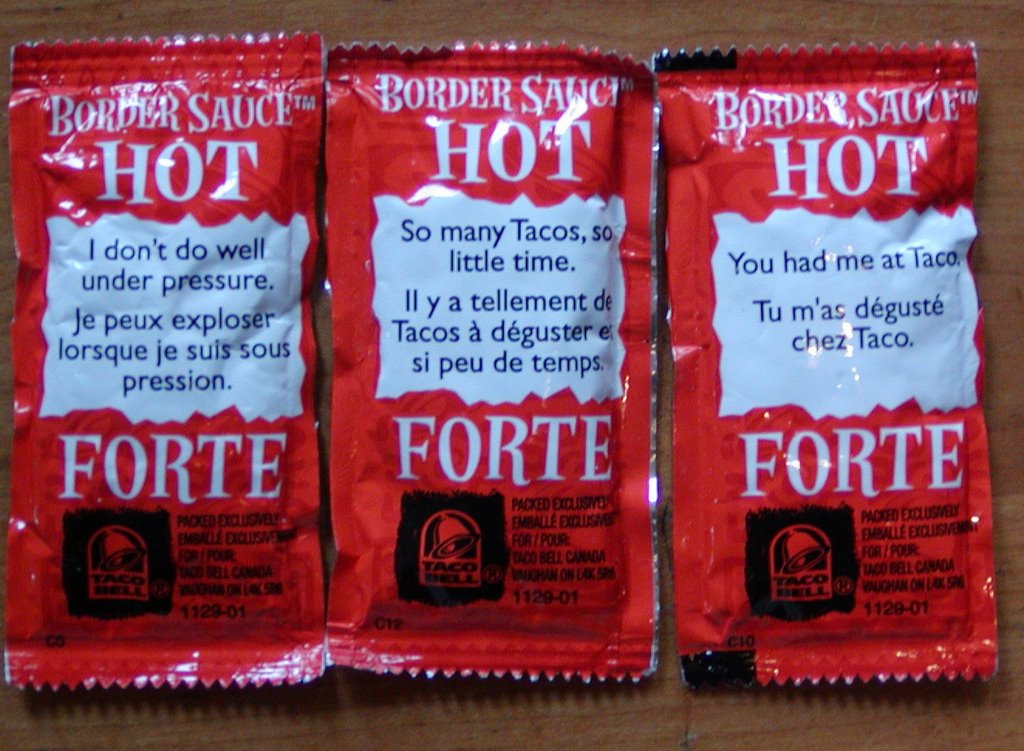
There are no Mexican restaurants in the town where I live, so every once in a while when I am really desperate, I go to the local Taco Bell. Recently this has been more fun than usual, since the little packets of taco sauce, which previously were unadorned, now sport "cute" sayings in both French and English. I like them for two reasons: first, they illustrate the conciseness of written English compared to written French, and second, because they illustrate how difficult it is to translate while retaining all the nuances. "You had me at Taco", for example, is evidently an illusion to the line "You had me at 'hello'" from the movie Jerry Maguire, while the translation (as far as I can see) doesn't even try to come up with a similar movie allusion from a French movie. (Readers, please correct me if I am wrong.)
On the other hand, if the folks at Language Log get hold of this, I'll probably learn why everything I just said is wrong.
Wednesday, September 20, 2006
Countering HIV Denialism: The Letter the AMS Wouldn't Print
Serge Lang was an eminent Yale mathematician who died in 2005. His life and work was the subject of a long obituary by Jay Jorgenson and Steven G. Krantz in the Notices of the American Mathematical Society in May 2006.
While Lang had many mathematical achievements, in his later years he began to show serious signs of crankiness, writing scathing letters to a wide variety of targets, including the American Mathematical Society (AMS) itself. Some of these targets, such as Samuel Huntington, were legitimate. Others were not. Lang became obsessed with correcting what appeared in some cases to be debatable or trivial inaccuracies, and even insisted on publishing his voluminous correspondence in books such as The File and Challenges. I remember leafing through The File in Cody's bookstore while a graduate student at Berkeley, wondering why an eminent mathematician would think his complaint letters would captivate an audience. To me, it seemed the sign of an ego out of control. Ever since then, I've seen many copies of The File in the "remainder" section of bookstores, suggesting that the publisher couldn't sell the number it unwisely chose to print.
One particular obsession stands out: although having no medical or biological training, Lang became active in the HIV denialist movement. Here is what Jorgenson and Krantz wrote in their May Notices obituary:
In the last twelve years of his life Serge Lang developed a deep and energetic program to fight the current directions of research on the diseases AIDS (Acquired Immune Deficiency Syndrome). A naive assessment of Serge's position is that HIV does not cause AIDS. But this would be an injustice to Serge. First of all, he was very careful. He very rarely made an error of fact. Secondly, he was quite a subtle thinker. His cause and his complaint, in fact, was that the search for a cure to AIDS had become politicized. At a certain point, the federal government simply commanded the National Institutes of Health to declare that HIV caused AIDS. The causal mechanism had not been identified, and the connection not logically established. To be sure, there is considerable ad hoc evidence of a link between HIV and AIDS. Certainly many of the modern treatments for AIDS are premised on that link. But Serge's assessment was that the existing data analysis does not support the conclusion that HIV causes AIDS.
The Notices then proceeded to give two-thirds of a page to the prominent denialist Peter Duesberg, who chose to use the space to repeat once again his long-debunked arguments against HIV as a cause of AIDS.
I felt the obituary and granting of space to Duesberg was inappropriate, and wrote the letter below to the editor of the Notices. Weeks went by with no acknowledgment, so I wrote again: no acknowledgment. I wrote again: no acknowledgment. Finally, after forwarding a copy to the Managing Editor, Sandra Frost, I got an e-mail message from the editor, Andy Magid, stating that the Notices would not publish my letter.
Here is what I wrote:
Dear Editors:
At the 16th International AIDS conference, which recently concluded in
Toronto, plenary speaker Stephen Lewis said, "[South Africa] is the
only country in Africa whose government continues to propound theories
more worthy of a lunatic fringe than of a concerned and compassionate
state."
The "lunatic fringe" theories Stephen Lewis was referring to are, of
course, precisely those advanced by Serge Lang. The objections of
HIV deniers have been carefully examined, and thoroughly demolished by
the medical community (for a good summary, see Stephen B. Harris, "The
AIDS Heresies", Skeptic, V. 3 No. 2 (1995)). The misinformation
campaign of Lang and other HIV deniers has misled South Africa's
President Thabo Mbeki and resulted in countless misery and death.
Given that, I found it grotesque that your recent obituary of Lang
[Notices of the AMS, V. 53 No. 5, May 2006] should attempt to whitewash
Lang's bizarre and ill-conceived attacks against HIV as a cause of
AIDS. And I found it appalling that you would give space to Peter
Duesberg, another leader of this destructive campaign, to extol Lang's
recklessness.
Lang's HIV denialism will stand as a testament to how an egotistical
confidence in one's expertise can lead to folly and destruction.
(Prof.) Jeffrey Shallit
School of Computer Science
University of Waterloo
While Lang had many mathematical achievements, in his later years he began to show serious signs of crankiness, writing scathing letters to a wide variety of targets, including the American Mathematical Society (AMS) itself. Some of these targets, such as Samuel Huntington, were legitimate. Others were not. Lang became obsessed with correcting what appeared in some cases to be debatable or trivial inaccuracies, and even insisted on publishing his voluminous correspondence in books such as The File and Challenges. I remember leafing through The File in Cody's bookstore while a graduate student at Berkeley, wondering why an eminent mathematician would think his complaint letters would captivate an audience. To me, it seemed the sign of an ego out of control. Ever since then, I've seen many copies of The File in the "remainder" section of bookstores, suggesting that the publisher couldn't sell the number it unwisely chose to print.
One particular obsession stands out: although having no medical or biological training, Lang became active in the HIV denialist movement. Here is what Jorgenson and Krantz wrote in their May Notices obituary:
In the last twelve years of his life Serge Lang developed a deep and energetic program to fight the current directions of research on the diseases AIDS (Acquired Immune Deficiency Syndrome). A naive assessment of Serge's position is that HIV does not cause AIDS. But this would be an injustice to Serge. First of all, he was very careful. He very rarely made an error of fact. Secondly, he was quite a subtle thinker. His cause and his complaint, in fact, was that the search for a cure to AIDS had become politicized. At a certain point, the federal government simply commanded the National Institutes of Health to declare that HIV caused AIDS. The causal mechanism had not been identified, and the connection not logically established. To be sure, there is considerable ad hoc evidence of a link between HIV and AIDS. Certainly many of the modern treatments for AIDS are premised on that link. But Serge's assessment was that the existing data analysis does not support the conclusion that HIV causes AIDS.
The Notices then proceeded to give two-thirds of a page to the prominent denialist Peter Duesberg, who chose to use the space to repeat once again his long-debunked arguments against HIV as a cause of AIDS.
I felt the obituary and granting of space to Duesberg was inappropriate, and wrote the letter below to the editor of the Notices. Weeks went by with no acknowledgment, so I wrote again: no acknowledgment. I wrote again: no acknowledgment. Finally, after forwarding a copy to the Managing Editor, Sandra Frost, I got an e-mail message from the editor, Andy Magid, stating that the Notices would not publish my letter.
Here is what I wrote:
Dear Editors:
At the 16th International AIDS conference, which recently concluded in
Toronto, plenary speaker Stephen Lewis said, "[South Africa] is the
only country in Africa whose government continues to propound theories
more worthy of a lunatic fringe than of a concerned and compassionate
state."
The "lunatic fringe" theories Stephen Lewis was referring to are, of
course, precisely those advanced by Serge Lang. The objections of
HIV deniers have been carefully examined, and thoroughly demolished by
the medical community (for a good summary, see Stephen B. Harris, "The
AIDS Heresies", Skeptic, V. 3 No. 2 (1995)). The misinformation
campaign of Lang and other HIV deniers has misled South Africa's
President Thabo Mbeki and resulted in countless misery and death.
Given that, I found it grotesque that your recent obituary of Lang
[Notices of the AMS, V. 53 No. 5, May 2006] should attempt to whitewash
Lang's bizarre and ill-conceived attacks against HIV as a cause of
AIDS. And I found it appalling that you would give space to Peter
Duesberg, another leader of this destructive campaign, to extol Lang's
recklessness.
Lang's HIV denialism will stand as a testament to how an egotistical
confidence in one's expertise can lead to folly and destruction.
(Prof.) Jeffrey Shallit
School of Computer Science
University of Waterloo
Wednesday, September 13, 2006
World's Tallest Tree Discovered
The San Francisco Chronicle reports that the world's tallest tree has been discovered in Redwood National Park. The tree, called "Hyperion", is 115.2 meters tall. (The previous record holder, a tree in Humboldt State Park, was only 112.8 meters tall.)
The tree is an area that was only added to the national park in the Carter administration, very close to an old clear cut. There's more information at the Sierra Club site here.
The tree is an area that was only added to the national park in the Carter administration, very close to an old clear cut. There's more information at the Sierra Club site here.
Tuesday, August 29, 2006
They're Proud of Their Ignorance
Take a look at this ebay auction for a book about rocks and minerals. What gets me is the description: "And no mention of Evolution!" They're not just ignorant, they're proud of it.
The auction is for a book in the Sonlight Science series, science books for homeschoolers. Sonlight also offers six books on creation/evolution: not a single valid book on biology in the bunch.
How long can fundamentalists continue to lie to their kids?
The auction is for a book in the Sonlight Science series, science books for homeschoolers. Sonlight also offers six books on creation/evolution: not a single valid book on biology in the bunch.
How long can fundamentalists continue to lie to their kids?
Tuesday, August 15, 2006
Alexandre Trudeau Whitewashes Castro
Alexandre Trudeau, son of Canadian Prime Minister Pierre Trudeau, has written a truly repulsive reminiscence of Fidel Castro. Trudeau depicts Castro as a "great adventurer", and calls him a "visionary statesman", "audacious", and "brilliant". Cuba, Trudeau says, is "privileged" to have had such a leader.
Nowhere in this grotesque encomium is there any hint that Castro executed and imprisoned thousands of his political opponents. I wonder if Armando Hernandez, who was executed by a Cuban firing squad in 1982 for the crime of painting anti-Castro slogans on bedsheets, would agree with Trudeau's assessment.
It seems that some segments of the Canadian Left are so blinded by their reflex anti-Americanism that they feel it necessary to whitewash the bloody records of dictators. Shame on them.
Nowhere in this grotesque encomium is there any hint that Castro executed and imprisoned thousands of his political opponents. I wonder if Armando Hernandez, who was executed by a Cuban firing squad in 1982 for the crime of painting anti-Castro slogans on bedsheets, would agree with Trudeau's assessment.
It seems that some segments of the Canadian Left are so blinded by their reflex anti-Americanism that they feel it necessary to whitewash the bloody records of dictators. Shame on them.
Tuesday, August 01, 2006
Which Creationist is Lying?
Which creationist is lying about the purpose of Kansas' science standards?
Is it board chairman Steve Abrams, who claims in the August 1 New York Times that the new science curriculum in no way opened the door to intelligent design or creationism and that any claim to the contrary “is an absolute falsehood.”
Or is it Joel Borofsky, Dembski's "research assistant", who says here, "It really is ID in disguise."
Is it board chairman Steve Abrams, who claims in the August 1 New York Times that the new science curriculum in no way opened the door to intelligent design or creationism and that any claim to the contrary “is an absolute falsehood.”
Or is it Joel Borofsky, Dembski's "research assistant", who says here, "It really is ID in disguise."
Subscribe to:
Posts (Atom)
